

Before you commit to custom tooling, ask about cavitation and component scope, whether the molding process fits your product, how firm the timeline really is, who maintains and replaces the mold over its life, and how quality holds up at scale. These five questions surface the costs and risks that a headline mold quote hides — and the answers tell you far more about a partner than the price does.
Custom tooling is one of the largest upfront investments in a packaging program, and it's one of the hardest to unwind once steel is cut. A low quote can mask maintenance you'll pay for later, a timeline that slips, or a process mismatch that limits your design. The questions below are the ones procurement and brand teams often skip — and the ones that separate a mold vendor from a tooling partner.
What Is Custom Tooling?
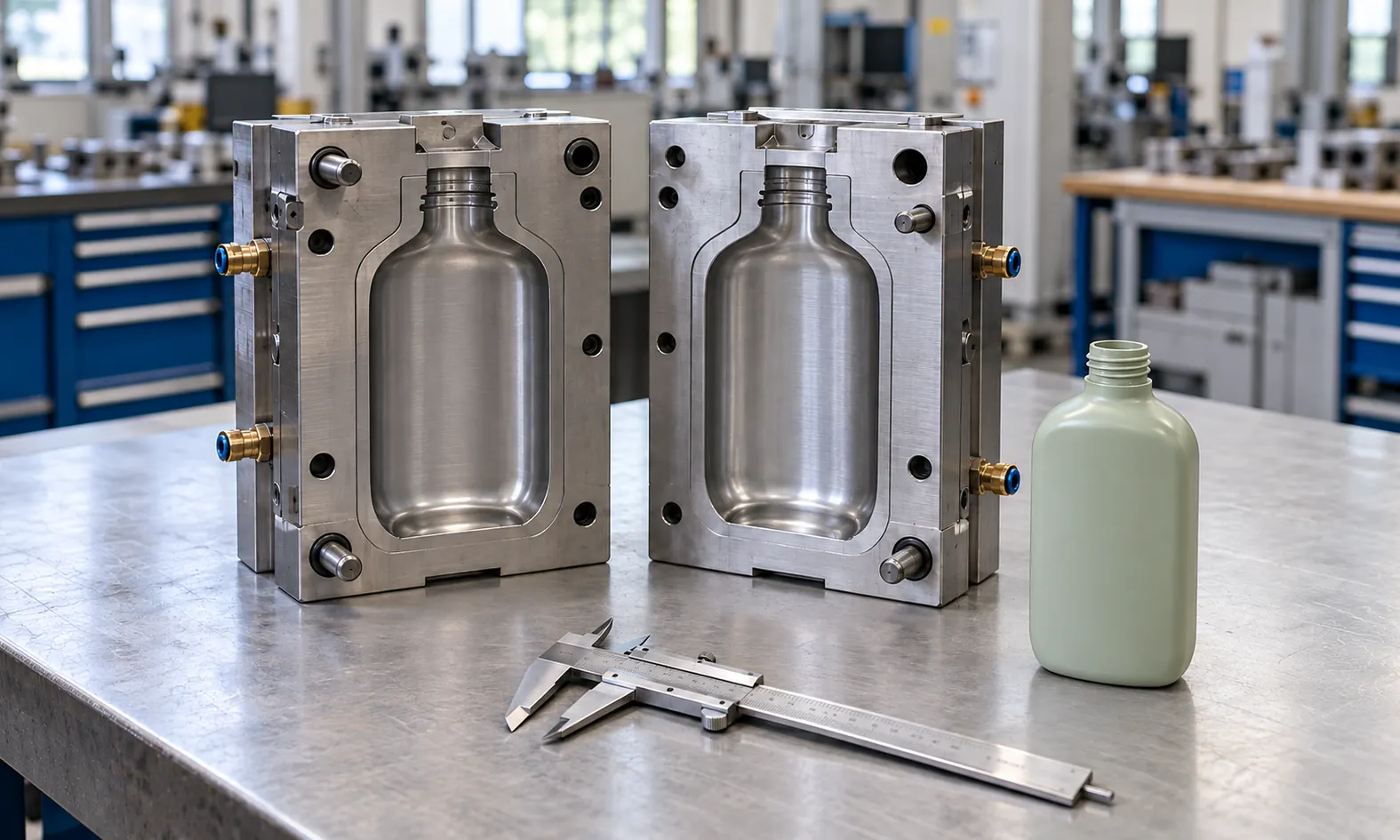
Custom tooling is the set of purpose-built molds, cavities, and dies engineered to produce a specific package rather than adapting an off-the-shelf component. In packaging, the tool defines a container’s shape, wall thickness, neck finish, and any embossed or debossed detail. Because every unit is formed from that tool, its design and upkeep directly determine part consistency, unit cost, and how well the package performs over a production run.
Is Custom Tooling Right for Your Product?
Custom tooling earns its cost when the package has to do something stock can't: carry the brand on its own, perform a function no catalog part offers, or use material more efficiently than a standard mold allows. It's worth a serious look when at least one of these is true:
- Packaging is part of your brand strategy. You want a shape or molded detail that customers recognize before they read the label.
- No stock option meets a functional need. A specific fill volume or footprint, a dispensing or ergonomic feature, closure fit, or a filling-line constraint that catalog parts don't solve.
- Volume and product life can pay back the tool. A long-running core SKU spreads the tooling cost across years of production; a limited edition rarely does.
- Your design is ready to freeze. Changes get expensive once steel is cut. 3D-printed prototypes and pilot molds are how you get there — if the design is still moving, validate before you tool.
If none of these apply, stock packaging with strong decoration — printing, hot stamping, sleeves, and labels — can deliver much of the differentiation at a fraction of the upfront cost. Many brands launch that way and move to custom tooling once demand is proven.
How Custom Tooling Helps Branding and Design
- An ownable silhouette. Shape is the first thing a shopper registers on the shelf, and a proprietary one can't be ordered from the same catalog by a competitor.
- Branding with no per-unit cost. Logos, wordmarks, textures, and grip patterns are formed in the mold, so every unit carries them at no added cost per unit — and unlike print or labels, they can't peel or rub off.
- Function built into the part. Ergonomic grips, dispensing features, stacking and nesting, and tamper-evident or child-resistant features can be engineered into the component instead of added on.
- Lighter, more recyclable designs. New tooling is often how a package loses weight or moves to a single material — the design step behind many lightweighting and mono-material projects.
How Your Material Changes the Decision
- Plastic offers the widest range of molding processes — injection, extrusion blow, injection blow, stretch blow, and thermoforming — plus deep stock catalogs, which makes partial tooling on a stock mold a common middle path. Injection molds are typically the most complex to build; blow molds are generally faster.
- Glass is where shape-as-brand is most common, especially in spirits: embossing, debossing, and distinctive silhouettes are all formed in the mold. Because glass is produced on continuously running furnaces, custom runs typically carry higher minimums, and molds need regular refurbishment over their life.
- Metal formats are largely built around standard diameters, so custom tooling usually targets the neck, shoulder shaping, embossing, or caps and lids rather than an entirely new body — and much of metal's branding happens through printing.
- Paper tubes and containers use comparatively simple tooling, making paper one of the faster formats to customize.
Stock, Partial, or Full Custom?
Custom tooling isn't all-or-nothing. Between a catalog package and a mold built from scratch sits partial tooling: a stock mold modified at specific points, such as the neck finish, base, or surface texture.
| Stock | Partial Tooling | Full Custom Tooling | |
|---|---|---|---|
| What it is | An existing catalog mold, used as-is | A stock mold modified at specific points | A new mold built to your exact design |
| Brand differentiation | Decoration only | A molded logo or detail on a familiar shape | An ownable shape plus molded-in features |
| Upfront tooling cost | None | Lower | Highest |
| Lead time | Fastest | Moderate | Longest |
| Volume needed to justify it | Lowest | Moderate | Highest |
| Changing the design later | Easy — switch to another stock item | Moderate | Hard — changes mean re-cutting steel |
| Best for | Launches, testing demand, limited editions | Established products that want differentiation without a full build | Flagship SKUs, proprietary formats, long product life |
| Example | A standard bottle with a printed label | A stock bottle with your logo embossed on the shoulder or base | A proprietary bottle shape with a molded-in logo |
5 Questions to Ask a Tooling Partner
Question 1: How Many Cavities — and How Many Components — Need Tooling?
What to look for: a partner who models cavitation against your real forecast, not a generic number.
Cavity count sets both your output and your per-unit economics. More cavities raise the mold's upfront cost but lower the cost per part at volume, so the right answer depends on your projected run rate, not a default. A strong partner walks you through that tradeoff and recommends a cavitation that matches your demand curve.
Just as important is knowing which components actually need their own tool. A custom trigger sprayer, for example, might require only the shroud and collar to be tooled, while the nozzle and inner mechanism stay stock. A good partner itemizes tooling by component and uses stock parts wherever possible to hold down cost.
Question 2: Is the Molding Process Right for Your Product?
What to look for: a recommendation driven by your product, not by the equipment the supplier happens to run.
The right process depends on material, format, shape complexity, and volume — injection molding for solid parts like caps and closures, extrusion blow molding for larger hollow containers, injection stretch blow molding for PET bottles, and heat-set PET for hot-fill formats. A partner limited to one process will steer you toward it whether or not it fits.
Ask the supplier to justify the process against your specific format and volume. The best answer explains why an approach is right and what its tradeoffs are. Evergreen has built thousands of molds across injection, blow, stretch blow, press, and thermoforming methods, which means the process recommendation follows the product rather than the plant.
Question 3: How Firm Is the Timeline — Really?
What to look for: a stage-by-stage schedule, not a single vague range.
Tooling timelines are where launches quietly slip. A credible partner breaks the schedule into pilot mold, sampling, trials & adjustments, approvals, and production tooling, and tells you what drives the range for your part. Pilot molds validate design before you invest in production tooling; production molds are built for durability across high-volume runs, and the two move on very different clocks.
For reference, Evergreen's pilot molds can be completed in 10-50 days (depending on the mold type and design complexity), with production blow molds averaging about 35 days and injection molds about 70, and 3D-printed prototypes delivered in as little as 48 hours for rapid validation. The specific figures matter less than whether a partner will commit to a timeline in writing at the start — and hold to it.
Question 4: Who Maintains and Replaces the Mold Over Its Life?
What to look for: clarity on maintenance and end-of-life replacement — before you sign.
Molds wear. Over thousands of cycles, cavities degrade, components fatigue, and eventually a tool needs refurbishment or replacement to keep parts within spec. In much of the industry, maintenance and replacement land back on the brand as an unplanned cost. Ask exactly who carries that burden, where the tool is stored, and how wear is monitored.
This is often the single most overlooked line item in a tooling decision, and it's where total cost of ownership is won or lost. Evergreen maintains and replaces tooling at its own cost for all active projects, so brands aren't hit with a fresh capital outlay when a mold reaches end of life — a distinction worth pressing every supplier to match.
Question 5: Will Quality Hold as You Scale Across Markets?
What to look for: quality managed at the source, with consistency across every facility that runs your tool.
A well-built mold only delivers if the production around it is disciplined. Ask how the partner controls quality during production — sample inspection, dimensional checks, statistical process control — and how consistency is maintained if your tool runs across multiple sites or regions.
Consistency at scale is a network question, not just a mold question. Every facility in Evergreen's network of 150+ qualified plants is audited across 165 quality management metrics, with QC engineers onsite at all productions globally — so issues are caught during the run rather than after goods ship.
| Question | A strong answer sounds like | A red flag sounds like |
|---|---|---|
| Cavities & components | Cavitation modeled to your forecast; tooling itemized per component | A flat cavity count with no volume rationale |
| Molding process | Process chosen for your product, with tradeoffs explained | "This is what we run," regardless of fit |
| Timeline | Stage-by-stage schedule committed in writing | A single wide range with no milestones |
| Maintenance & replacement | Clear ownership, storage, upkeep, and end-of-life terms | Silence on who pays when the mold wears out |
| Quality at scale | Source-level QC and cross-facility consistency | Inspection only at final delivery |
Choosing a Tooling Partner You Won't Outgrow
The right custom tooling decision isn't about finding the lowest mold quote — it's about finding a partner whose answers hold up over the full life of the tool. Cavitation, process fit, timeline discipline, maintenance, and quality control compound across every production run, and a weak answer in any one of them tends to surface at the worst possible moment.
Evergreen approaches tooling as a long-term program, not a one-time build. To see how that works for your product, visit our page on Custom Tooling or Get in Touch to discuss your packaging requirements.