


Global Manufacturing Network
Over the past two decades, we have established a global portfolio of trusted manufacturing facilities across glass, metal, plastic, and sustainable categories. Evergreen employees are onsite at all major locations to ensure consistent quality, reliable capacity, and on-time delivery.
Risk mitigation via multiple qualified facilities
Expanded capacity and reduced resource constraints
Optimized freight through volume aggregation
Cross-supplier and multi-field collaborations
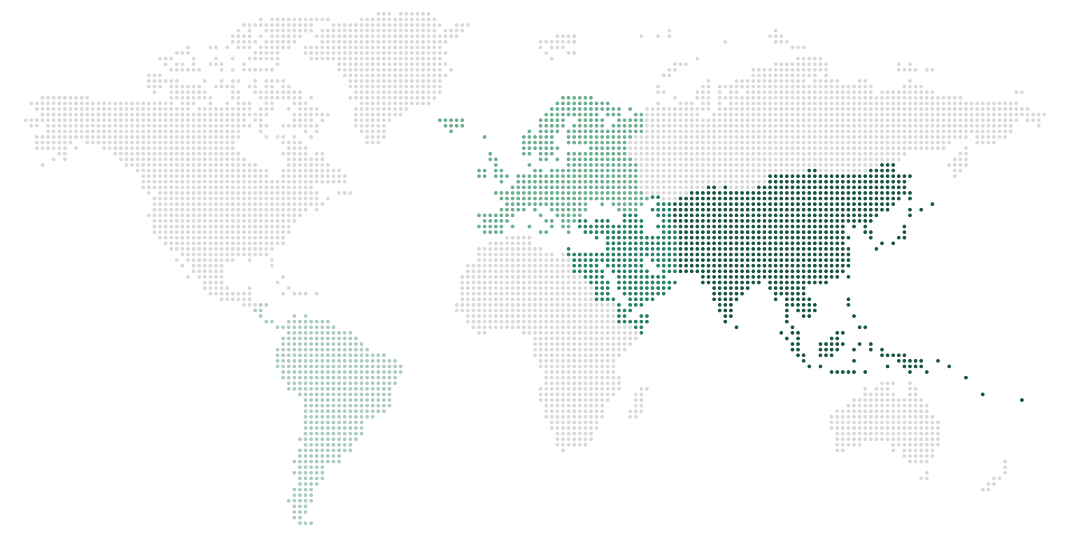

Asia
Aerosol
Glass
Metal
Molded plastics
Dispensing
Laminated tubes
Extrusion tubes
Paper
Bio-resin
Flexible Packaging

Middle East
Aerosol
Glass
Metal

Europe
Aerosol
Glass
Metal
Molded plastics
Laminated tubes
Extrusion tubes
Bio-resin
Flexible Packaging

South America
Aerosol
Glass
Metal

Working with Evergreen, companies get access to multiple qualified facilities around the world that meet their requirements at competitive pricing.
Global Coverage That Supports Supply Chain Stability
In today’s volatile environment, having access to a global supplier network is a key strategy for reducing supply chain risk. When companies work with partners that operate qualified facilities across multiple regions, they gain geographic diversification — an important safeguard against disruptions. This type of global footprint helps ensure supply continuity even when individual regions face constraints.
Minimizing Risk and Maximizing Uptime Through Supplier Redundancy
Supply chains are increasingly vulnerable to unexpected events — from natural disasters and raw material shortages to political or economic instability. By working with partners that have multiple qualified sites, companies can avoid total dependence on a single location. This redundancy allows for more flexibility in rerouting orders, shifting capacity, or scaling production as needed, all while minimizing delays and business impact.
Supporting Long-Term Resilience and Business Continuity
Beyond short-term protection, a multi-facility supply model helps build long-term resilience. It improves access to essential resources, reduces lead time variability, and supports consistent quality standards across markets. For businesses looking to protect product performance and delivery timelines at scale, supply redundancy is not just a risk-mitigation tactic — it’s a foundational element of operational continuity.
We're Here To Help
Frequently Asked Questions

01
Global manufacturing reduces supply chain risk by distributing production across multiple regions, so no single disruption — whether a natural disaster, political instability, or capacity constraint — can halt your supply. When one facility or region is affected, production can be rerouted to alternative qualified locations without interrupting delivery timelines. Evergreen's network of 150+ facilities is structured precisely for this redundancy, and delivered zero missed shipments during the COVID-19 pandemic.
02
A single domestic supplier concentrates all supply chain risk in one location, one capacity pool, and one regulatory environment. When that supplier faces a delay, material shortage, or demand surge from other customers, there is no alternative source to absorb the impact. Working with a supplier like Evergreen Resources that operates qualified facilities across multiple regions is the most effective way to eliminate that exposure.
03
A global manufacturing network reduces packaging costs by enabling strategic sourcing — selecting production locations based on material costs, capacity availability, and tariff conditions at any given time. Domestic suppliers are limited to one cost structure, with no flexibility to shift production when input costs rise or trade policy shifts. Evergreen takes this approach across its global manufacturing network, allocation production to the most cost-efficient and available facilities at any given time.
04
Consistent quality across multiple facilities is achievable when a supplier maintains unified audit standards, onsite personnel, and standardized production protocols across its entire network. Without these controls, quality variation between facilities is a common failure point — and a risk that fragmented sourcing amplifies. Evergreen audits every facility across 165 quality management metrics and stations QC engineers onsite at all productions globally.
05
Overseas packaging lead times typically consist of 30 days for production, plus 30–60 days for transit depending on the origin region — totalling 60–90 days from order to delivery. While this may appear longer than domestic lead times, overseas lead times from a well-managed global supplier such as Evergreen Resources are significantly more stable and predictable. That stability is what matters most for procurement planning — a consistent 90-day lead time is far easier to manage than a domestic supplier whose lead times fluctuate with capacity constraints.
06
Global sourcing does not inherently mean longer lead times — it depends on the structure of the supplier's network and logistics capabilities. A well-managed global supplier can often deliver faster than a domestic-only supplier at capacity, because production can be allocated to facilities with available throughput. Evergreen's average production lead time is 30 days and transit time is 30-60 days, supported by local safety inventory programs for brands that need to buffer against demand variability.
07
Geographic diversification gives brands the flexibility to shift sourcing between regions as tariff conditions change, reducing exposure to any single trade policy or duty structure. Brands locked into a single country of origin have no mechanism to adapt when new tariffs are imposed or trade agreements shift. Suppliers with qualified facilities across multiple regions can proactively adjust production allocation to protect cost stability — a capability that has become essential since the tariff volatility of 2025.
08
Visibility and control in overseas production comes down to whether you have trusted personnel onsite at every facility, or are relying on remote oversight alone. Brands managing quality from a distance cannot catch and resolve issues before goods are packed and shipped — the first sign of a problem is often a non-conforming delivery. Evergreen QC engineers are onsite at all productions globally, ensuring every shipment is quality-certified before it leaves the facility — not discovered to be non-conforming when it arrives.