


Chemical can openings and closures are critical design features for packaging solvents, fuels, coatings, adhesives, lubricants, cleaning chemicals, and other industrial products. They affect how the container is filled, sealed, opened, poured, reclosed, and used throughout the product life cycle.
Although many chemical cans may look similar from the outside, their opening and closure systems can be very different. Options such as REL opening, DIN opening, continuous-thread closures, pull-up spouts, open-head designs, and tight-head structures each serve different packaging needs. Understanding these opening and closure types helps packaging teams select the right configuration for filling efficiency, sealing performance, dispensing control, reclosure reliability, and end-user convenience.
Open-Head and Tight-Head Structures

Open-head and tight-head are broad structural classifications. They describe how the top of the can is constructed and how the user accesses the product.
An open-head can has a removable lid or cover. When the lid is removed, the user has access to the full top opening of the container. This structure is commonly used when the product needs to be brushed, scooped, mixed, stirred, or accessed directly from the container. Because the opening is wide, open-head containers are suitable for thicker products such as paints, coatings, adhesives, greases, sealants, and paste-like materials. The main advantage is full product access, while the main limitation is that it provides less controlled pouring and exposes more product surface after opening.
A tight-head can has a fixed, non-removable top. Instead of removing the full lid, the product is filled and dispensed through one or more smaller openings. These openings may use REL apertures, continuous-thread closures, plugs, pull-up spouts, or other closure systems. Tight-head structures are commonly used for liquid chemicals, solvents, fuels, lubricants, and cleaning products because they provide more secure containment and better control during storage and transportation. The limitation is that the user cannot fully access the inside of the container, so this structure is less suitable for very thick products or applications that require stirring, brushing, or scooping directly from the can.
REL and DIN Opening
REL and DIN openings are both filling aperture designs used on metal chemical cans and canisters. They describe the formed opening on the can, not the overall can structure. Both may be used on tight-head chemical cans, but the shape of the opening and the way the closure seats on the can are different.
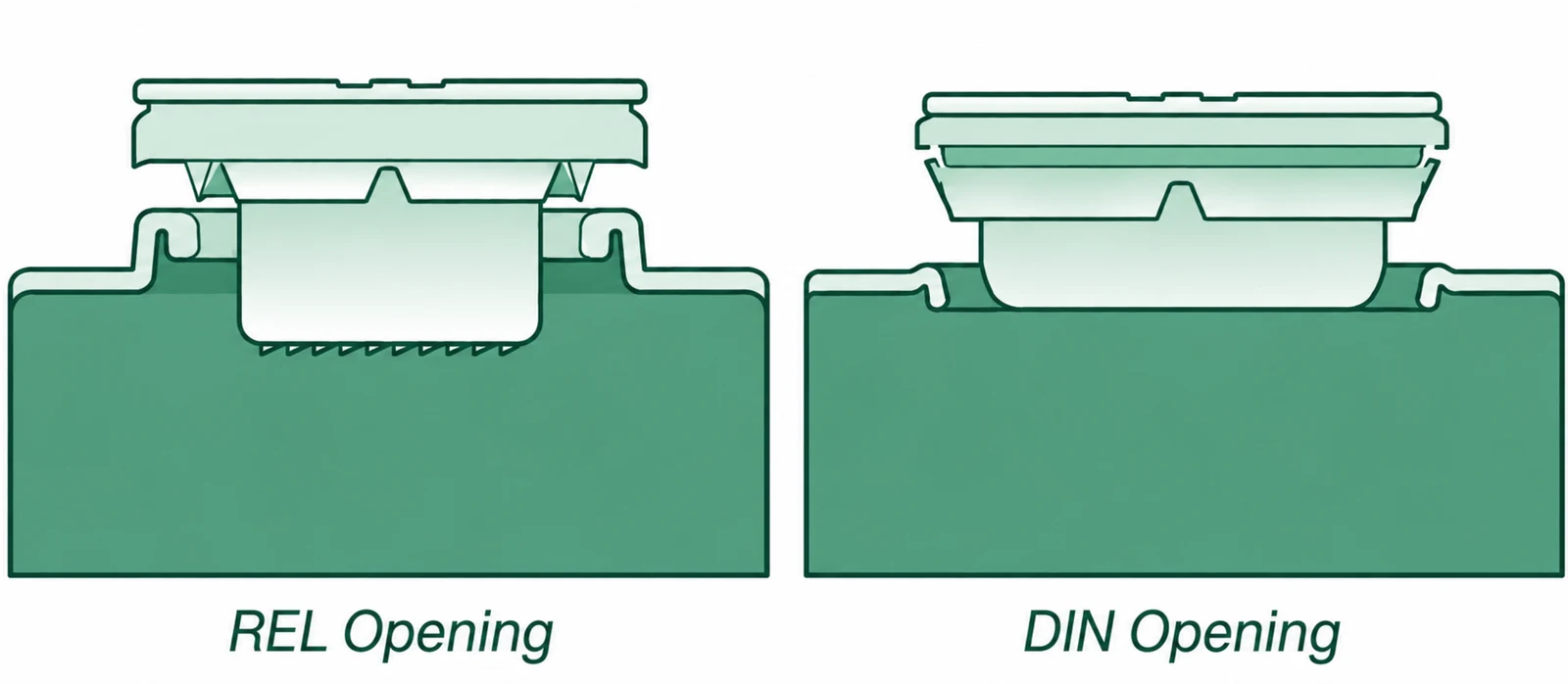
- A DIN opening is the older aperture style. In a DIN design, the collar or formed edge is generally shaped downward into the can top rather than projecting upward. Because there is no raised external collar around the filling aperture, the closure is pressed more directly into the opening area. This design can still provide a functional seal when paired with the correct closure, but it provides less guidance for closure placement and may be less forgiving during mechanical closing.
- A REL opening was developed as an improved filling aperture for chemical canisters. The key feature of REL is the raised collar or projecting rim around the opening. Instead of pressing the closure directly into a flatter top area, the closure is seated over, into, or around the raised collar. This raised rim helps guide the closure into the correct position, improves pouring from the opening, and supports better product emptying.
The main difference between REL and DIN is the direction and function of the collar. In a REL opening, the collar is raised upward around the filling aperture. In a DIN opening, the collar is formed downward, so the top surface does not provide the same raised guide feature. As a result, REL is generally easier to recognize from its raised neck profile and is often preferred for improved pouring performance and closure application.
Continuous-Thread Openings and Closures
Alpha, Beta, and Delta are best grouped together as continuous-thread openings and closures. They all use the same basic mechanism: a threaded neck on the can and a matching screw cap. The term continuous thread means the closure uses an uninterrupted spiral thread. The user opens and closes the container by twisting the cap, similar to a standard screw-cap bottle.
A continuous-thread opening has a round raised neck with external threads. The cap has matching internal threads. When the cap is turned clockwise, the threads pull the cap downward onto the sealing surface. When the cap is turned counterclockwise, the cap moves upward and can be removed. This design is familiar to end users, easy to reclose, and useful when the product needs to be dispensed multiple times.
Alpha vs. Beta vs. Delta
Alpha, Beta, and Delta use the same screw-cap principle, but they differ by standard finish size and opening diameter. The selection depends on the required flow rate, product viscosity, filling process, and end-user dispensing needs.
- Alpha is generally a smaller continuous-thread closure option. It is used when the customer needs a compact, resealable opening with good pouring control. Because the opening is smaller, Alpha can help reduce over-pouring and is suitable for small-volume dispensing. However, the smaller opening may slow filling and pouring, and it may not be the best option for thicker products or applications that require faster dispensing.
- Beta is also a continuous-thread closure, but it is a different standard finish size from Alpha. It is often selected when a balance between control and practical flow is needed. Beta provides the same familiar screw-cap operation and resealability, while offering a slightly different opening configuration depending on the can and closure design. It is commonly suitable for general liquid chemical packaging. However, like other smaller threaded openings, it may still be limited for high-viscosity products or applications requiring high flow.
- Delta is generally a larger continuous-thread closure option. It uses the same twist-on and twist-off mechanism as Alpha and Beta, but the larger opening allows faster filling and pouring. Delta may be preferred for larger-volume products or moderate-viscosity liquids where improved flow is important. The tradeoff is that a larger opening may provide less pouring control for low-viscosity liquids if the user pours too quickly. The larger cap and sealing area also require proper closure application to maintain sealing performance.
| Finish | Typical size | Main difference | Typical benefit |
|---|---|---|---|
| Alpha | 1-1/4 in. | Smaller standard finish. | Better control and compact opening. |
| Beta | 1-1/8 in. | Different standard finish from Alpha. | Balance between control and flow. |
| Delta | 1-3/4 in. | Larger opening diameter. | Faster filling and pouring. |
Pull-Up Spout Closure
A pull-up spout closure is a dispensing closure designed to improve pouring convenience. It is commonly used on tight-head containers or containers where the user needs better directional control during pouring.
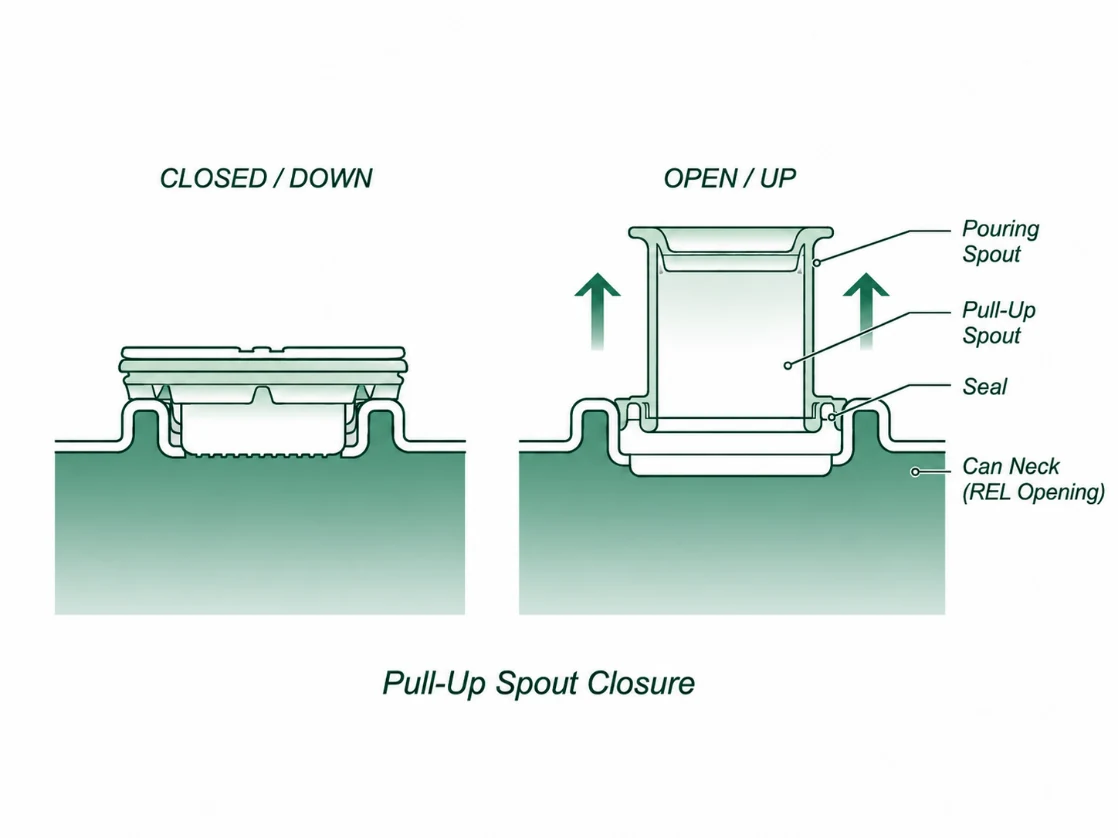
In the closed position, the spout sits low in the closure and remains compact for shipping and storage. When the user is ready to dispense the product, the spout is pulled upward. Once raised, it forms a short pouring neck that directs the liquid flow. This makes the closure different from a standard screw cap, where the main action is simply removing and reinstalling the cap.
The main advantage of a pull-up spout is improved pouring direction. It can help reduce splashing, dripping, and uncontrolled flow, especially when pouring from larger containers into equipment or smaller containers. However, the design is more complex than a basic screw cap and may cost more. The spout area also needs to remain clean after use, especially for products that may dry, crystallize, or clog around the spout.
Choosing the Right Chemical Can Configuration
Chemical can openings and closures should be selected based on the product type, filling process, dispensing method, and end-user requirements. Open-head and tight-head designs describe the overall can structure, while REL, DIN, continuous-thread closures, and pull-up spouts describe specific opening or closure systems. REL openings use a raised collar to improve closure positioning and pouring performance, while DIN openings are an older aperture style with the collar formed downward. Alpha, Beta, and Delta are continuous-thread closure options with different standard sizes, offering different balances between pouring control, resealability, and flow rate.
Evergreen supports customers in selecting appropriate chemical can structures, openings, and closures based on product application and packaging requirements. Whether the project requires an open-head can for full product access, a tight-head can for secure liquid containment, a REL opening for improved pouring, or Alpha, Beta, and Delta threaded closures for resealable dispensing, Evergreen can help review the available options and recommend a practical packaging configuration that supports filling efficiency, sealing performance, and end-user convenience. Get in touch with us today.