

The European Union's Packaging and Packaging Waste Regulation (PPWR), Regulation (EU) 2025/40, introduces new requirements for how packaging is designed, manufactured, documented, used, and managed at the end of its life.
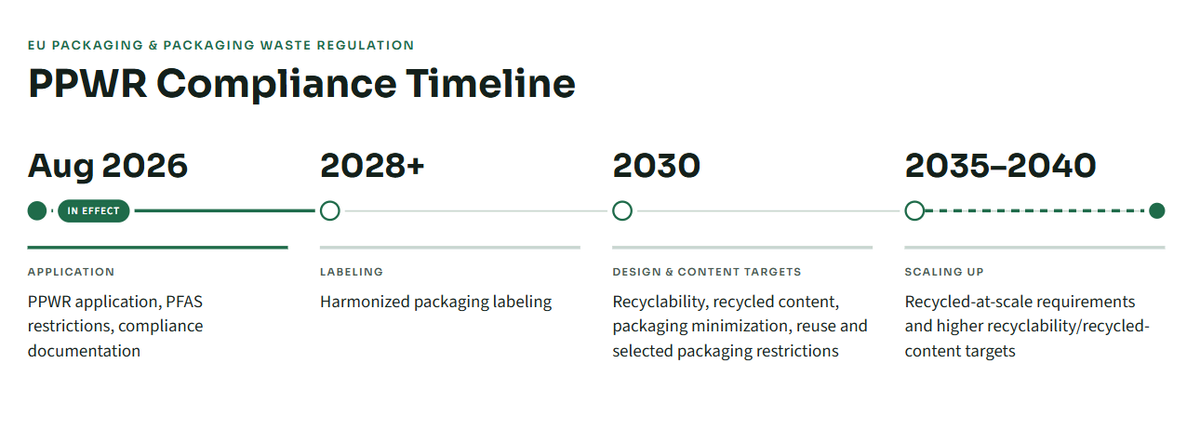
Rather than taking effect through one single deadline, the PPWR introduces requirements in stages from 2026 through 2040. This article highlights the key milestones that are most relevant to packaging users and suppliers, including PFAS restrictions, compliance documentation, labeling, recyclability, recycled content, packaging minimization, and reuse requirements.
PPWR Overview
The PPWR replaces the previous EU Packaging and Packaging Waste Directive and establishes a more harmonized regulatory framework across EU Member States. It applies broadly to packaging placed on the EU market, including plastic, glass, metal, paper, and other packaging materials.
The Regulation entered into force on February 11, 2025, and became generally applicable on August 12, 2026. Major packaging design requirements will continue to phase in through 2030 and beyond.
Reference: Regulation (EU) 2025/40 – EUR-Lex
August 2026 — PPWR Begins to Apply
1. PFAS Restrictions for Food-Contact Packaging
From August 12, 2026, food-contact packaging cannot be placed on the EU market if it contains PFAS at or above the specified limits:
- 25 ppb for any individual PFAS measured by targeted analysis
- 250 ppb for the sum of targeted PFAS
- 50 ppm for PFAS, including polymeric PFAS
These limits are established under Article 5 of the PPWR.
For companies using or purchasing food-contact packaging, compliance may require reviewing more than the primary container material. Coatings, liners, adhesives, barrier layers, inks, and surface treatments may also need to be evaluated. Companies should obtain appropriate supplier declarations, material information, or test reports to support PFAS compliance.
Reference: PPWR Article 5 – Requirements for Substances in Packaging
2. Compliance and Technical Documentation
The PPWR also strengthens documentation and conformity responsibilities. Manufacturers must assess packaging against applicable PPWR requirements and maintain supporting technical documentation. Where required, an EU Declaration of Conformity must be issued before packaging is placed on the market.
For customers purchasing packaging, this means supplier documentation will become increasingly important. Companies should maintain accurate packaging specifications and obtain supporting information such as material composition, chemical compliance records, test reports, supplier declarations, and other documentation needed to demonstrate conformity.
This also means that a general statement that packaging is “PPWR compliant” may not be sufficient. Compliance should be supported by documentation applicable to the specific packaging and requirement.
Reference: Regulation (EU) 2025/40 – Manufacturer and Conformity Requirements
2028 Onward — Harmonized Packaging Labeling
The PPWR introduces a harmonized EU labeling system intended to make packaging material identification and waste sorting more consistent.
The labeling requirement will generally apply from August 12, 2028, or 24 months after the relevant implementing acts enter into force, whichever is later. Packaging covered by the requirement will need standardized information indicating its material composition.
For companies selling packaged products into the EU, this may require updates to packaging artwork, labels, molded markings, and packaging specifications. Maintaining accurate material information now will make future artwork and labeling changes easier to manage.
Reference: PPWR Article 12 – Labelling of Packaging
2030 — Major Packaging Design Requirements
The most significant PPWR changes for packaging design begin around 2030. The European Commission identifies recyclability, recycled plastic content, packaging reduction, reuse, and restrictions on certain single-use packaging among the major requirements applying from this stage.
1. Design for Recycling
The PPWR introduces recyclability performance grades based on the percentage of packaging that is recyclable by weight:
| Grade | Recyclability Performance |
|---|---|
| A | ≥95% |
| B | ≥80% |
| C | ≥70% |
| Technically non-recyclable | <70% |
Packaging will generally need to meet at least Grade C once the design-for-recycling criteria become applicable.
For companies developing or purchasing packaging, recyclability should be considered at the complete package level. Closures, liners, labels, adhesives, coatings, sleeves, and other components can affect the recyclability of the final package. Maintaining an accurate packaging Bill of Materials and component specifications will therefore become increasingly important.
Reference: PPWR Article 6 – Recyclable Packaging
2. Minimum Recycled Content for Plastic Packaging
The PPWR establishes minimum post-consumer recycled content requirements for plastic packaging.
| Plastic Packaging Category | 2030 Minimum |
|---|---|
| Contact-sensitive PET packaging* | 30% |
| Contact-sensitive non-PET plastic packaging* | 10% |
| Single-use plastic beverage bottles | 30% |
| Other plastic packaging | 35% |
*Excluding single-use beverage bottles and subject to applicable exemptions.
For companies using plastic packaging, recycled content will become an important sourcing and specification requirement. Companies may need documentation confirming recycled-content percentages and traceability while also considering product-contact requirements, appearance, mechanical performance, and material consistency.
Reference: PPWR Article 7 – Minimum Recycled Content in Plastic Packaging
3. Packaging Minimization and Empty Space
By 2030, packaging weight and volume must be reduced to the minimum necessary to maintain packaging functionality. The PPWR also introduces a maximum 50% empty-space ratio for certain grouped, transport, and e-commerce packaging, subject to the applicable implementation timeline.
For companies, this means packaging dimensions, material weight, secondary packaging, protective materials, and shipping configurations may need to be reviewed. Packaging should be sized and designed based on product protection, transportation, filling, safety, and other functional requirements rather than unnecessary material or excessive empty space.
Companies should maintain packaging dimensions, weight specifications, testing results, and other information that can support the selected design.
Reference: PPWR Articles 10 and 24 – Packaging Minimisation and Empty Space
4. Reuse and Selected Single-Use Packaging Restrictions
From 2030, reuse targets apply to certain transport and sales packaging formats. For specified transport packaging, the PPWR establishes a general 40% reusable packaging target, subject to exemptions and detailed application rules.
The PPWR also restricts certain single-use packaging formats listed in Annex V.
For companies, the key consideration is not only what material the packaging is made from, but also how the packaging is used within the supply chain. Businesses should review applicable transport packaging, reuse opportunities, and single-use packaging formats to determine whether changes will be required.
Reference: PPWR Article 29 and Annex V – Reuse and Packaging Restrictions
2035–2040 — Higher Circularity Requirements
From the 2035 stage, recyclability will increasingly consider whether packaging is actually recycled at scale, not simply whether it is technically designed to be recyclable. This means collection, sorting, and established recycling infrastructure will become increasingly relevant.
By 2038, packaging will generally need to achieve at least Grade B recyclability, meaning Grade C packaging will no longer meet the applicable performance threshold.
In 2040, minimum recycled-content targets for plastic packaging will also increase further, reaching up to 65% for certain packaging categories.
For companies, packaging development should therefore consider not only the next compliance deadline, but also whether new packaging designs and material systems are likely to remain suitable as PPWR requirements become more demanding.
Reference: PPWR Articles 6 and 7 – Future Recyclability and Recycled Content Requirements
How to Prepare for PPWR Compliance
PPWR compliance will require companies to understand both their packaging design and the supporting information behind it. Key areas to prepare include:
- Accurate packaging material and component specifications
- PFAS and other applicable chemical compliance documentation
- Recyclability and component compatibility information
- Recycled-content declarations and traceability
- Packaging weight, dimensions, and minimization records
- Technical documentation and supplier declarations
Companies should also continue monitoring PPWR delegated acts, implementing acts, and technical standards, as several detailed methodologies are still being developed.
Evergreen Resources continues to monitor PPWR development and work with our facilities globally to strengthen packaging specifications, material documentation, traceability, and compliance records. By incorporating changing regulatory requirements into packaging development and supplier management, Evergreen aims to help customers prepare for PPWR requirements while maintaining the performance and functionality required for their packaging applications.
Reference: European Commission – Packaging & Packaging Waste Regulation
FAQ
What is the EU Packaging and Packaging Waste Regulation (PPWR)?
The Packaging and Packaging Waste Regulation (PPWR), Regulation (EU) 2025/40, establishes harmonized EU requirements for packaging design, materials, recyclability, recycled content, labeling, reuse, and waste reduction. It applies broadly to packaging placed on the EU market, including plastic, glass, metal, and paper packaging.
When does the PPWR take effect?
The PPWR entered into force on February 11, 2025, and became generally applicable on August 12, 2026. Additional requirements are being phased in through 2030 and beyond, including labeling, recyclability, recycled-content, minimization, and reuse requirements. Evergreen recommends evaluating both current requirements and future milestones when developing packaging for the EU market.
What are the PPWR PFAS limits for food-contact packaging?
Beginning August 12, 2026, food-contact packaging cannot be placed on the EU market if PFAS concentrations meet or exceed specified PPWR limits, including 25 ppb for an individual targeted PFAS, 250 ppb for the sum of targeted PFAS, and 50 ppm for total PFAS measured using the specified approach. Packaging components such as coatings, liners, inks, adhesives, and barrier layers may also need to be evaluated.
What documentation is needed for PPWR compliance?
PPWR compliance may require technical documentation demonstrating that packaging meets applicable regulatory requirements, along with an EU Declaration of Conformity where required. Depending on the packaging, supporting records may include material specifications, chemical compliance information, test reports, recycled-content documentation, and supplier declarations. Evergreen works with its facilities to maintain packaging specifications and supporting compliance records.
What are the PPWR recyclability requirements for 2030?
From 2030, packaging subject to the PPWR design-for-recycling requirements will generally need to achieve at least Grade C recyclability, corresponding to 70% or more recyclable by weight under the applicable methodology. Closures, labels, liners, adhesives, coatings, and other components can influence the recyclability assessment of the complete package.
How much recycled content will plastic packaging need under PPWR?
From 2030, minimum post-consumer recycled-content requirements vary by plastic packaging category. Targets include 30% for certain contact-sensitive PET packaging, 10% for certain contact-sensitive non-PET plastic packaging, 30% for single-use plastic beverage bottles, and 35% for other plastic packaging, subject to applicable exemptions. Evergreen customers should consider recycled-content availability, traceability, product-contact requirements, and package performance when developing new specifications.
Does PPWR require companies to reduce packaging size and empty space?
Yes. PPWR requires packaging weight and volume to be minimized to what is necessary for functionality and introduces a maximum 50% empty-space ratio for certain grouped, transport, and e-commerce packaging under the applicable implementation timeline. Companies should be prepared to support packaging dimensions and material usage with appropriate specifications and performance requirements.
How can companies prepare for PPWR compliance?
Companies can prepare by maintaining accurate packaging specifications, reviewing PFAS and other chemical requirements, documenting material composition and recycled content, evaluating recyclability, and reviewing packaging weight and dimensions. Because additional PPWR methodologies and implementing rules continue to develop, Evergreen will continue working with its facilities to strengthen documentation, traceability, and packaging specifications as requirements evolve.