

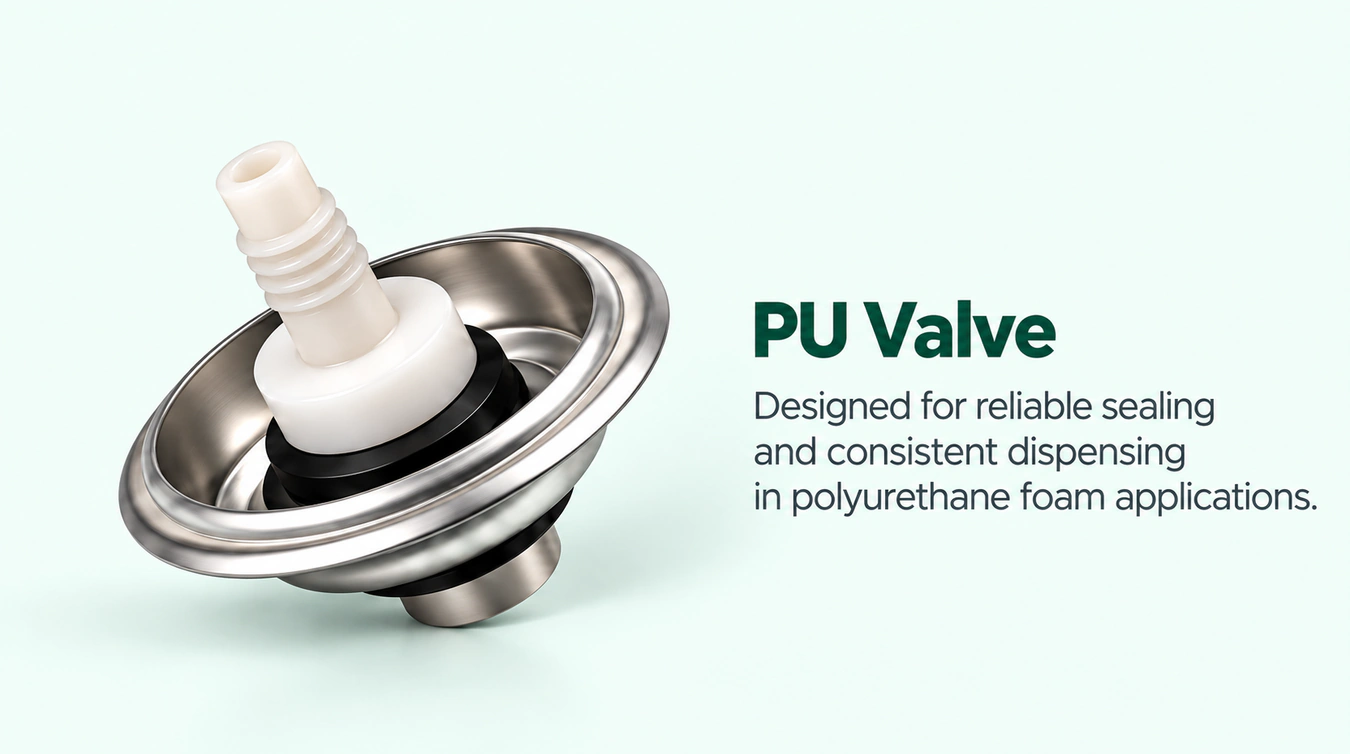
Polyurethane (PU) foam products are commonly packaged in pressurized aerosol containers, where the valve plays an important role in maintaining package integrity and controlling product dispensing.
Although a PU valve is relatively small compared with the complete package, its performance depends on the interaction of several components, materials, and manufacturing processes. Dimensional variation, damaged sealing components, improper assembly, or leakage can directly affect how the valve functions.
This guide provides a practical overview of what a PU valve is, how its main components work together, how it is manufactured, and which quality characteristics are important to reliable valve performance. It also introduces Evergreen’s quality-control process for PU valves, from incoming inspection through final product release.
Overview of PU Valves
A PU valve is an aerosol valve designed for pressurized polyurethane foam products.
During storage, the valve remains closed to maintain the sealed condition of the container. When the valve stem is actuated, the valve opens a flow path that allows the pressurized product to move through the valve and into the applicable dispensing device. When the actuation force is removed, the valve returns to its closed position.
For PU foam applications, reliable sealing is particularly important because the product is stored under pressure and its performance can be affected by exposure to the external environment.
A properly functioning PU valve therefore needs to provide two basic functions:
- maintain a reliable seal during storage and transportation; and
- open and close consistently during dispensing without sticking.
The exact valve design, dimensions, materials, and dispensing configuration can vary depending on the product and application.
PU Valve Structure
PU valve designs can vary, but the basic system normally includes a stem, grommet, mounting cup, and mounting-cup gasket.
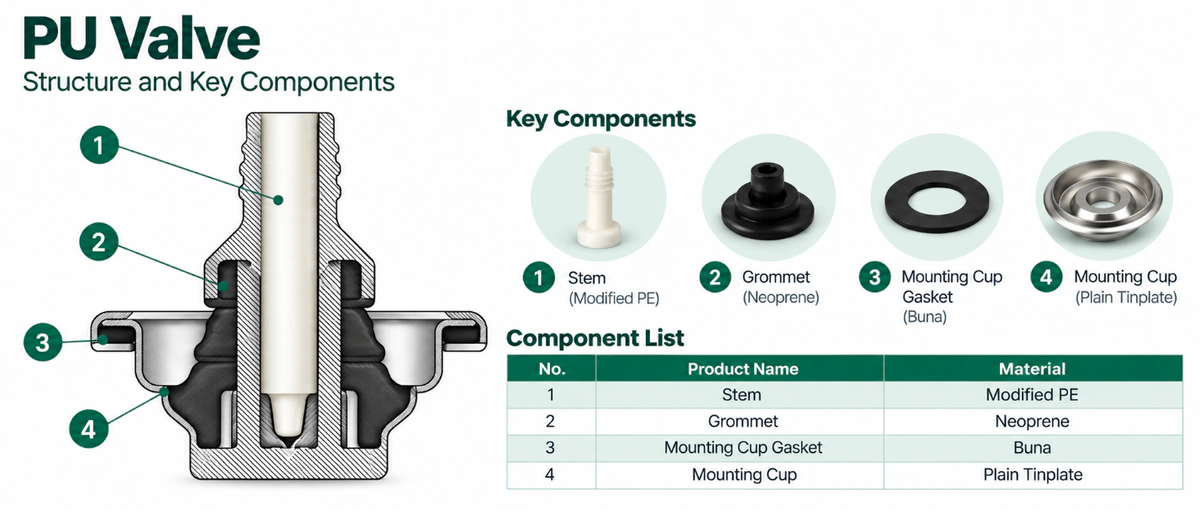
| Component | General Function |
|---|---|
| Stem | Provides the product flow path and interfaces with the dispensing system |
| Grommet | Seals around the stem and provides the flexibility required for valve movement and return |
| Mounting Cup | Supports the valve assembly and provides the structural connection to the aerosol container |
| Gasket | Helps create a pressure-tight seal between the mounting cup and the container |
Stem
The stem is the movable component through which the product is dispensed. When the stem is actuated, the sealing interface opens and allows the product to enter the internal flow passage.
Because the stem interacts directly with the sealing components and dispensing system, its dimensions and surface condition need to remain consistent.
Grommet
The grommet is an elastomeric component positioned around the stem. It provides the primary sealing interface around the stem while also allowing controlled valve movement.
Its elasticity helps the stem return to its normal position after actuation. Cracks, damage, dimensional variation, or unsuitable material properties can therefore affect both sealing and valve movement.
Mounting Cup
The mounting cup is the metal structural component that holds the valve assembly and connects it to the aerosol container.
During final aerosol-package assembly, the mounting cup is mechanically secured to the container opening. Its dimensions and formed features must therefore remain consistent to support proper assembly and sealing.
Mounting Cup Gasket
The mounting-cup gasket provides sealing between the valve cup and the aerosol container.
The gasket must maintain sufficient sealing performance after the valve is installed and throughout the intended use of the package.
Although each component has a different function, final valve performance depends on how these components work together as a complete assembly.
Production Process
PU valve manufacturing combines several different production processes because the valve contains plastic, elastomeric, and metal components.
A typical production flow can be summarized in the following steps.
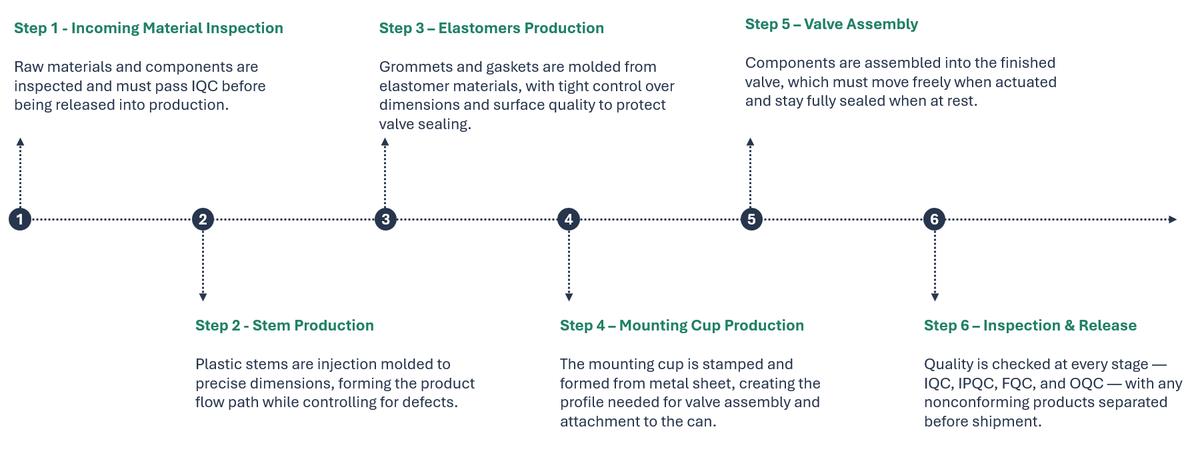
Step 1 – Incoming Material Inspection
Raw materials and purchased components are received and inspected before entering production.
Material identity, appearance, condition, and applicable technical requirements are verified to help prevent nonconforming materials from entering the manufacturing process.
Evergreen's documented quality flow requires incoming materials to pass IQC inspection before being released to the raw-material warehouse and production.
Step 2 – Stem Production
Plastic stems are typically produced through injection molding.
The process forms the external stem geometry and internal product flow path. Important manufacturing controls include dimensional consistency, molding condition, surface quality, and the prevention of defects such as deformation or excessive flash.
Step 3 – Elastomer Component Production
The grommet and gaskets are produced from specified elastomer materials.
The molding process must maintain consistent dimensions, flexibility, and surface condition. Cracks or other defects in these components are particularly important because they can affect valve sealing.
Step 4 – Mounting Cup Production
The mounting cup is produced from metal sheet through stamping and forming operations.
These operations create the cup profile and the features required for valve assembly and subsequent installation onto the aerosol container.
Consistent metal forming is important because deformation or dimensional variation can affect both assembly and final sealing.
Step 5 – Valve Assembly
The individual components are assembled into the finished valve.
The stem is positioned within the sealing system, while the grommet and gasket are incorporated into the mounting-cup assembly. The assembled valve must allow controlled stem movement while maintaining the required sealed condition when the valve is not actuated.
Step 6 – Inspection and Release
Quality inspections are performed throughout manufacturing rather than relying only on final inspection.
Evergreen's documented process includes IQC, IPQC, FQC, and OQC, covering incoming materials, component production, assembly, finished-product inspection, and outgoing inspection before shipment. Nonconforming products are separated and handled through the applicable nonconforming-product procedure.
Quality Standards and Evergreen Quality Control
For PU valves, quality cannot be evaluated by appearance alone. Several characteristics directly affect whether the valve will seal and function properly in application. Evergreen manages PU valve quality through a structured control process covering incoming materials, in-process production, assembly, finished-product inspection, and outgoing inspection.
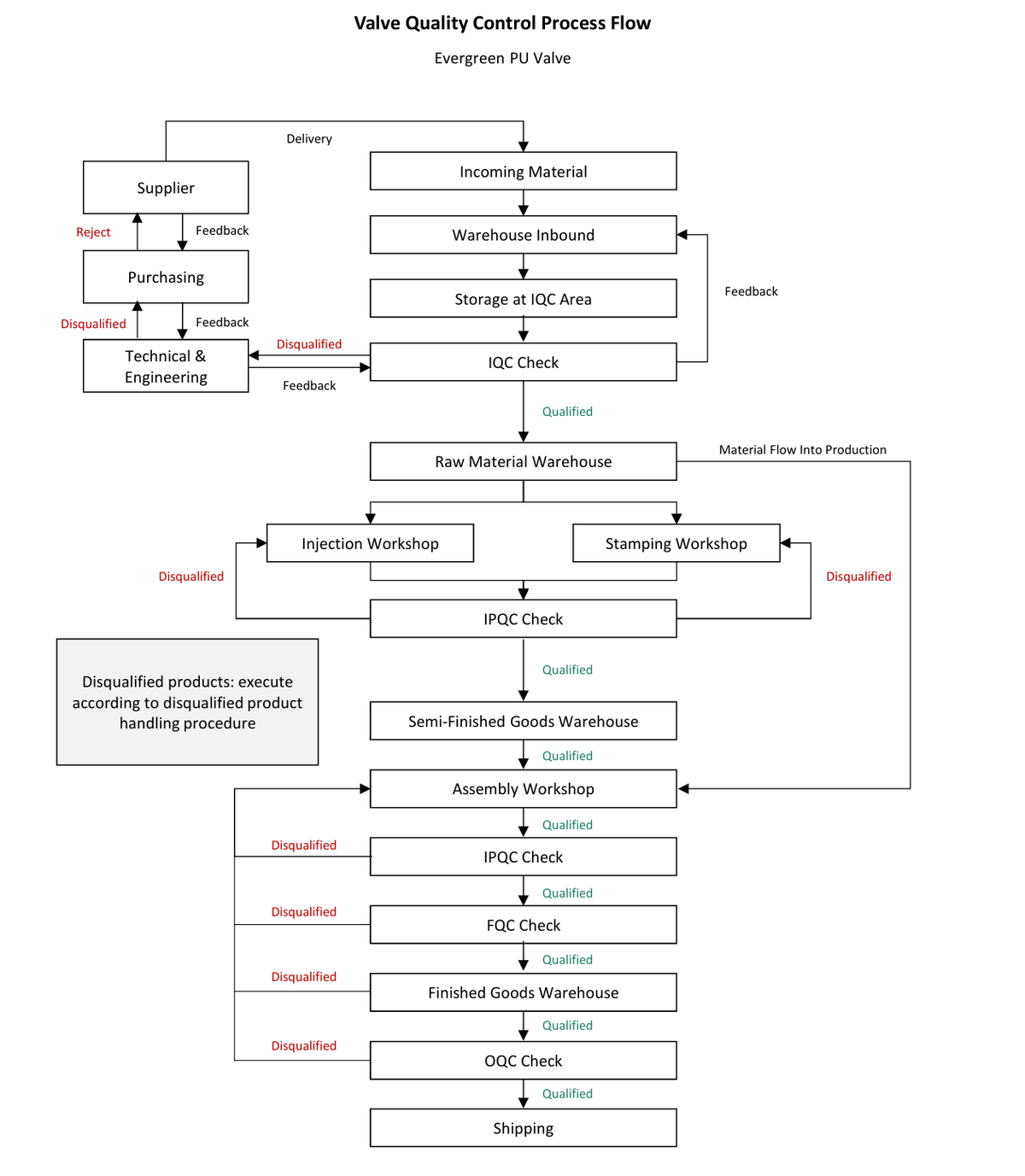
Evergreen's valve quality control process begins with incoming material receipt and IQC inspection, followed by raw material release to production, component manufacturing, assembly, finished-product inspection, and outgoing inspection before shipment. The documented process includes IQC, IPQC, FQC, and OQC, and nonconforming materials or products are handled according to the applicable disqualified product procedure.
Dimensional Control
Dimensions affecting the interaction between the stem, grommet, mounting cup, aerosol container, and dispensing system must be carefully controlled.
Because PU valve designs vary, the exact dimensions and tolerances depend on the specific valve design. Evergreen therefore verifies the key dimensional characteristics defined for each applicable product specification.
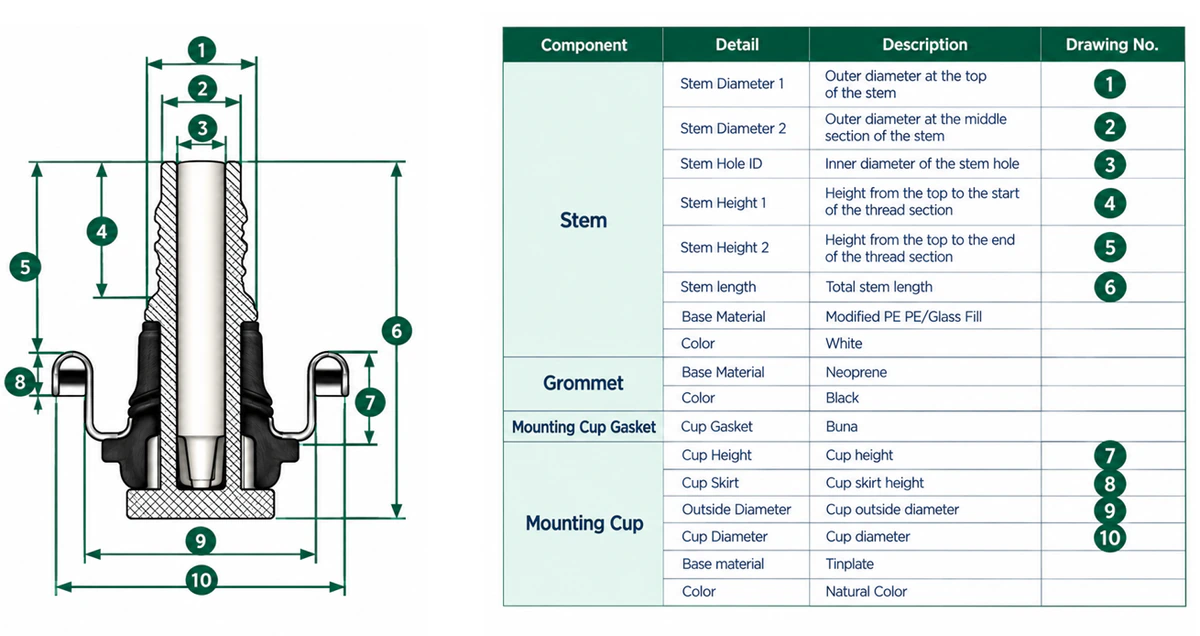
The PU valve inspection checklist includes the following major dimensions:
- Stem Diameter 1
- Stem Diameter 2
- Stem Hole ID
- Stem Height 1
- Stem Height 2
- Stem Length
- Cup Height
- Cup Skirt Height
- Cup Outside Diameter
- Cup Diameter
Controlling these critical dimensions ensures proper component fit, valve movement, container compatibility, and assembly consistency.
Leakage Control
Leakage is one of the most important functional concerns for a pressurized valve system.
Potential leakage can result from damaged sealing components, improper assembly, component dimensional variation, or defects in the mounting cup.
To verify the sealing performance of the completed aerosol package, Evergreen recommends that customers perform a 100% inline water-bath leak test on the filling line after filling and valve installation. The recommended test condition is 0.85 MPa for 1 minute.
In addition to functional testing, visual inspection specifically checks for conditions that can create leakage risk, including:
- missing stem;
- missing gasket or grommet;
- cracks in the grommet; and
- cracks in the mounting cup.
These conditions are treated more seriously because they can directly affect the ability of the valve to maintain a seal.
Stem Material and Sticking Resistance
The valve stem material is an important factor in PU valve performance, particularly in preventing sticking during long-term contact with polyurethane foam formulations.
Evergreen uses a modified polyethylene-based material for the valve stem. Rather than using unfilled polyethylene alone, the material is formulated with additional components to improve its functional performance. The composition generally includes:
- Polyethylene as the primary resin;
- Mineral filler, such as talc, to modify stiffness and dimensional stability;
- Titanium dioxide for color and material consistency; and
- Stabilizing additives to support long-term material performance.
This modified polyethylene formulation was developed to provide functional performance comparable to glass-filled polyethylene while maintaining the characteristics required for PU valve applications.
Material selection is particularly important because polyurethane foam is moisture-curing. Small amounts of product remaining around the stem and grommet interface can cure and harden over time, potentially increasing friction or causing the valve stem to stick. The stem material must therefore maintain dimensional stability and suitable surface performance after prolonged exposure to the PU formulation.
To evaluate this risk, Evergreen performs sticking resistance testing using filled OCF aerosol cans under accelerated temperature and humidity conditions. Samples are stored at 55°C and ≥95% relative humidity for 60 days, with both vertical and horizontal orientations evaluated. The valves are checked at 7-day intervals for sticking and leakage. Before each functional check, the samples are cooled to room temperature and actuated to verify that foam can still dispense normally. A successful test requires no stuck valves and no leakage throughout the entire test period.
Because PU foam formulations can differ in chemistry, Evergreen recommends confirming sticking resistance with the intended formulation as part of valve qualification. This helps verify that the selected stem material and complete valve system remain compatible and functional under the specific application conditions.
Valve Movement and Rebound
The stem must move properly when actuated and return after the actuation force is removed.
Evergreen's inspection criteria, therefore, include the inability of the stem to rebound as a functional defect.
As an additional package-level functional check, Evergreen recommends that customers perform a 100% inline water-bath jam test on the filling line after filling and valve installation. The recommended test pressure is 0.50 MPa.
Monitoring these characteristics helps identify problems related to component fit, sealing-component condition, or assembly.
Structural and Visual Integrity
The mounting cup and sealing components must also remain free from defects that could affect either function or final product quality.
Evergreen's visual inspection includes checks for:
- cracked mounting cups;
- cracked grommets;
- depressed or bulged cups;
- missing components; and
- oil stains or variegated surface spots.
The same key inspection characteristics are incorporated into Evergreen's finished-product inspection checklist, which records visual, dimensional, and functional inspection results before product release.
By applying quality controls at multiple stages of production, potential issues can be identified before they affect the finished valve.
Ensuring Reliable PU Valve Performance
PU valve performance depends on more than one individual component. Reliable operation requires consistent materials, component dimensions, sealing surfaces, metal forming, assembly, and functional performance.
The stem, grommet, mounting cup, and gasket must work together to maintain sealing during storage while allowing the product to be dispensed when required. Because small variations or defects can affect the complete valve system, quality control throughout manufacturing is essential.
At Evergreen Resources, PU valve quality is managed from incoming-material inspection through component manufacturing, assembly, finished-product inspection, and outgoing quality control. Dimensional, visual, and functional inspections are used together to verify the characteristics that are most important to valve sealing and operation.
Through controlled manufacturing and multi-stage quality inspection, Evergreen Resources works to provide consistent and reliable PU valve solutions for pressurized packaging applications.