

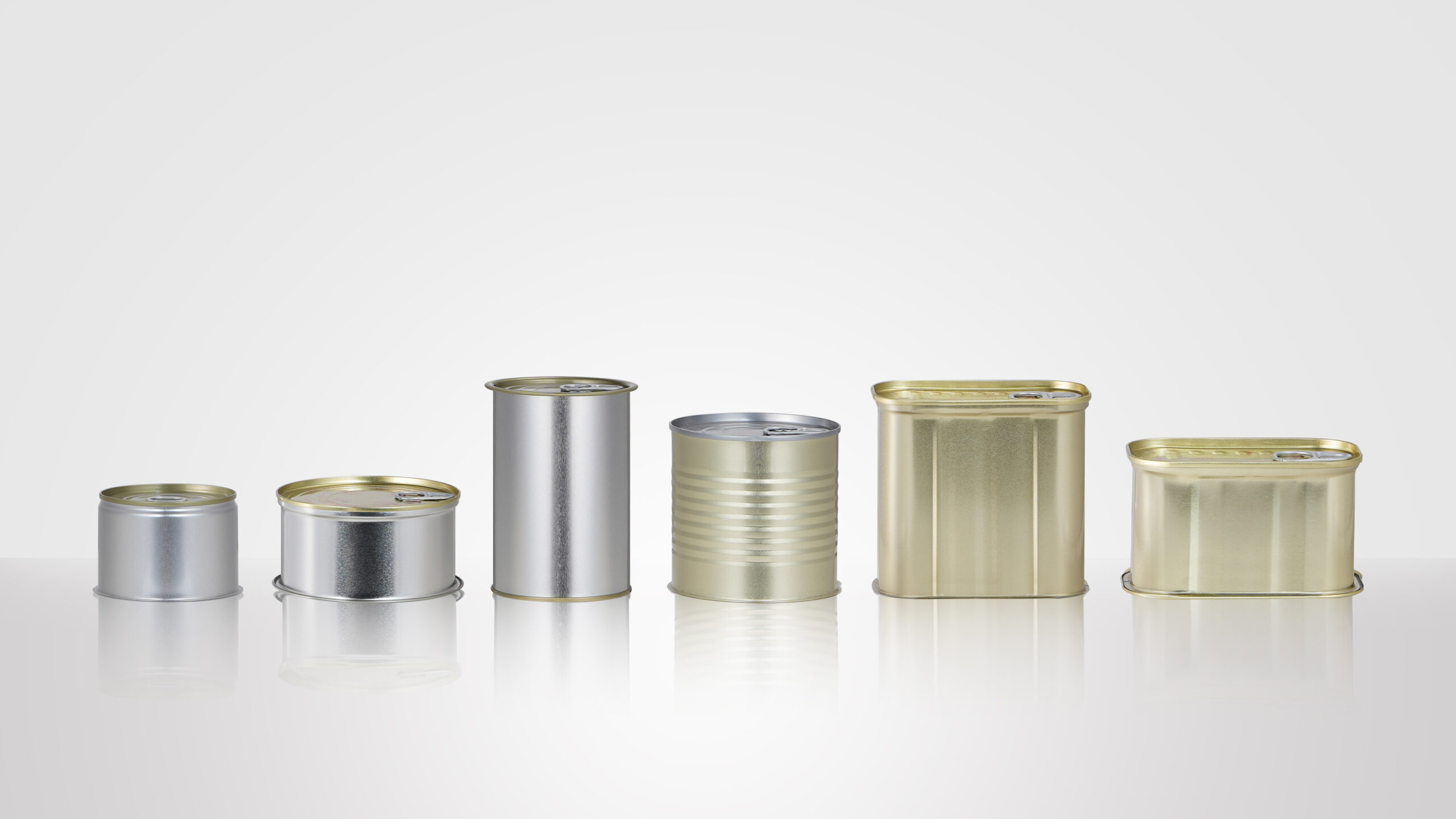
The 3-piece can construction method has been the industry standard for metal food packaging for decades, and remains the dominant format for canned vegetables, fruits, soups, pet food, and industrial food ingredients. Understanding how a 3-piece can is constructed, where its critical performance parameters lie, and how material choices affect both manufacturing and end-use performance is essential for any brand or procurement team specifying metal food packaging.
3-Piece Can Construction
A 3-piece food can is built from three separately manufactured metal components — a cylindrical body, a top end, and a bottom end. The body is formed from a flat sheet of tinplate or steel, rolled into a cylinder, and joined along a welded side seam. The top and bottom ends are then mechanically attached to the body through double seaming to form a hermetically sealed container.
The following components within a 3-piece can each play a defined role in the structural and functional performance of the finished can:
- Can Body — The cylindrical body forms the primary structural shell of the can. After welding, ribs or an oblong profile may be formed using a shaping mold to improve rigidity. The body is the main determinant of dent resistance, stacking strength, and vacuum retention.
- Top and Bottom Ends — The metal ends are attached to the body through double seaming. For food applications, the top end may be a standard sanitary end or an easy-open end, depending on the product type and consumer-use requirements.
- Welded Side Seam — The vertical seam where the body sheet is joined must remain strong, leak-free, and fully protected by coating. Any seam defect — burn-through, coating damage, or incomplete fusion — is a potential failure point for both integrity and food safety.
- Double Seams — The double seam mechanically joins the can body to each end, forming the hermetic seal that protects product through filling, retort processing, distribution, and shelf life. A sealing compound is applied to the ends prior to seaming to ensure consistent sealing performance.
- Internal Coating — A protective lining applied to the interior of the can prevents direct metal-to-product contact and inhibits corrosion. Internal coating selection is particularly critical for acidic, tomato-based, or high-salt products, where an incompatible coating can compromise both packaging integrity and food safety.
- External Coating and Print — The external surface carries both the decorative finish and an outer protective coating. This layer serves a dual purpose: delivering brand identity and shelf appeal while protecting the can body from external corrosion during storage and distribution.
Manufacturing Process
3-piece food can manufacturing follows a defined sequence of forming, joining, and finishing operations. Each step builds on the last — dimensional or quality issues introduced early in the process compound through subsequent stages, making process control at every step essential.
- Sheet Preparation: Tinplate or steel sheets are selected based on the required gauge, temper, coating system, and food-contact specification. Where required, the material is printed and externally coated prior to body forming — sequencing decoration before forming ensures consistent print registration and coating adhesion.
- Body Blank Cutting: Sheets are cut into rectangular body blanks sized to the required can diameter and height. Dimensional accuracy at this stage directly affects body circumference and side seam alignment in subsequent operations.
- Body Forming: Each blank is rolled into a cylindrical shape, with the two side edges aligned in preparation for welding. Consistent edge alignment is critical to side seam quality — misalignment at this stage cannot be fully corrected during welding.
- Side Seam Welding: The aligned body edges are welded to form the cylindrical can body. The weld must achieve consistent strength, continuity, and dimensional accuracy across the full seam length. Incomplete fusion, burn-through, or dimensional inconsistency at the weld are rejection criteria.
- Side Seam Coating: The exposed metal at the weld zone is coated immediately after welding to restore corrosion protection. This step is particularly critical for products with high acidity or salt content, where unprotected metal at the seam represents a direct food safety and shelf-life risk.
- Flanging: The top and bottom edges of the can body are flanged outward to prepare for end attachment. Flange geometry must fall within specification — undersized or cracked flanges will produce defective double seams downstream.
- Beading and Rib Forming: Body ribs are formed into the sidewall to improve rigidity, vacuum resistance, and dent resistance. Rib design and depth are particularly important for taller cans and for products subject to retort processing, where internal pressure and vacuum cycling place significant mechanical demands on the body.
- Bottom End Seaming: The bottom end is attached to the body by double seaming, forming one sealed end of the can prior to filling. Double seam parameters — clasp length, overlap, and tightness — must be verified at this stage before cans proceed to the filling line.
- Filling and Top End Seaming: The product is filled and the top end is seamed onto the body to form a hermetically sealed package. Top end seam integrity is subject to the same parameter requirements as the bottom end, and is the last opportunity to identify seaming issues before the can enters thermal processing.
- Retort and Thermal Processing: Sealed cans are thermally processed through retort or sterilization where the product requires it. The can must withstand the full pressure and temperature cycle — including heating, holding, and cooling — without leakage, paneling, end distortion, or internal coating failure. Can performance under retort conditions is directly influenced by material selection, rib design, seam integrity, and coating system — all of which are determined in the steps preceding this one.
Quality Assurance and Inspection Process
3-piece food cans are subject to rigorous quality requirements at every stage of production. Because these containers are used in food processing environments — including retort sterilization, high-speed filling lines, extended warehousing, and retail distribution — any deviation in seam integrity, dimensional accuracy, or coating condition can affect food safety, filling line performance, and shelf life. A structured, multi-stage inspection process is not optional; it is a baseline requirement for any supplier producing to commercial food packaging standards.
The inspection framework below covers the control points that must be verified before finished cans are approved for shipment.
Pre-Inspection Review
Before any physical inspection begins, the relevant specification package must be confirmed. This includes the approved drawing, customer purchase order details, dimensional tolerances, material and coating requirements, packaging specifications, and any previously documented quality concerns.
This step is never skipped in order to avoid downstream problems — particularly when multiple SKUs or revision levels are in production simultaneously. All inspection activity must be tied to the correct, current and approved specification.
Product Appearance Inspection
Visual inspection covers the can body, top and bottom ends, weld seam, internal coating, external coating, and printed surface. Inspectors check for deformation, dents, cracks, rust, contamination, coating peeling, exposed metal, and printing defects including color accuracy, barcode legibility, and artwork registration.
The weld seam requires particular attention: burn-through, sharp edges, or coating damage at the weld are rejection criteria. Flanging and ribbing must be free of cracks or wrinkles that would compromise downstream seaming.
Dimensional Verification
Critical dimensions are verified against the approved drawing, with tolerances confirmed before production release. Standard measurements include can height, body diameter, seaming diameter, flanging width, rib depth, and wall thickness where specified.
Dimensional non-conformance is one of the most common causes of filling line downtime. Cans that fall outside seaming diameter tolerance, for example, can cause double-seam failures or line stoppages — problems that are far more costly to resolve at the filler than at the point of inspection.
Seaming and Sealing Integrity
Seam integrity is the most critical quality control point for 3-piece food cans. The mechanical join between the can body and the top and bottom ends must meet defined parameters for body clasp length, top and bottom clasp length, overlap length, and overlap percentage.
Sealing performance is verified through pressure and vacuum testing. The standard protocol involves filling the can with compressed air to 50 kPa, holding for two minutes, then applying a 50 kPa vacuum and holding for a further two minutes. No leakage or permanent deformation should be observed. Any seam defect that passes visual inspection but fails under pressure or vacuum testing is grounds for lot rejection.
Strength and Handling Performance
Food cans must withstand stacking, palletizing, transportation, and warehouse storage without compromising integrity. Performance checks typically include air pressure resistance, longitudinal compression strength, static stacking capacity, dent resistance, and — where applicable — vacuum performance following retort processing.
These tests simulate the mechanical stresses a can will encounter from the point of production through to retail. Cans that meet dimensional and seam specifications but fail under compression or handling loads represent a latent supply chain risk.
Packaging Inspection
Finished can packaging is inspected to confirm correct packing quantity, carton and tray condition, pallet stability, stretch wrap integrity, and accurate lot labeling. Mixed items, damaged outer packaging, or unstable pallet configurations are rejection criteria — not just cosmetic concerns.
Proper packaging protects inspection-compliant cans from becoming non-compliant during transit. A can that arrives at the filler damaged, contaminated, or mislabeled creates the same operational problem as one that failed inspection at source.
Documentation and Traceability
A complete documentation package must accompany each production lot. This includes raw material certificates or COAs, tinplate information, coating and lacquer data, food-contact compliance documents where required, production lot records, and inspection results.
Documentation review is not a formality. Without a verified paper trail, it is impossible to conduct a meaningful root cause investigation if a quality issue emerges downstream — and regulatory traceability requirements for food-contact packaging make this a compliance matter, not just an internal preference. Evergreen Resources verifies this documentation package at the source before any lot is approved for shipment, ensuring that traceability is established at the point of production rather than reconstructed after the fact.
Final Inspection Result
Shipment should only proceed once all inspection results have been reviewed and the lot formally accepted. Any non-conformances must be documented with descriptions, photographs, and a defined disposition.
Releasing a lot with unresolved quality concerns transfers risk to the filler, and ultimately to the end consumer. A rigorous final release process is what separates suppliers who manage quality from those who only record it. At Evergreen, no lot proceeds to shipment until inspection results meet the approved specification — and where concerns are identified, they are resolved with the customer before goods move.
Industry Trend: Lightweighting in 3-Piece Food Cans
Lightweighting — also referred to as downgauging — is an established industry direction driven by material cost reduction and sustainability goals. Reducing tinplate gauge lowers the raw material content per can and decreases the carbon footprint of production and transport.
However, lightweighting is not a straightforward substitution. Thinner tinplate affects retort performance, dent resistance, stacking strength, vacuum retention, and compatibility with high-speed filling lines. Any downgauging program must be validated against these performance requirements before production use.
Downgauging: Balancing Gauge Reduction with Performance
Lightweighting typically involves reducing tinplate thickness while increasing temper — using harder, stiffer material to compensate for the reduction in gauge. The table below shows representative downgauging transitions currently being developed and validated by Evergreen Resources:
| Standard Material | |
|---|---|
| Tinplate Gauge | Temper |
| 0.21mm | T4 |
| 0.23mm | T4 |
| Downgauged Material | |
|---|---|
| Tinplate Gauge | Temper |
| 0.17mm | DR8 |
| 0.17mm | T5 |
| 0.19mm | T5 |
The appropriate downgauging path depends on the customer's product type, filling process, retort conditions, and distribution requirements. A single gauge reduction target does not apply universally — validation must be conducted on a product-specific basis.
Testing and Verification Requirements
Because reduced tinplate thickness can affect both manufacturing performance and end-use integrity, downgauging requires a structured, three-stage verification process before any material change is approved for production.
1. Can Manufacturing Process Validation
The first stage confirms that the new gauge performs acceptably through the can-making process itself. Key checks include:
- Flanging: No cracks or wrinkles at the flange
- Ribbing: No deformation or wrinkles through the ribbing operation
- Seaming quality: Body clasp length, top and bottom clasp length, overlap length, and overlap percentage must all fall within the approved specification
Manufacturing process validation must be completed before any offline quality testing begins. A gauge that cannot be reliably formed and seamed is not a viable candidate, regardless of its material properties.
2. Offline Quality Verification
Once manufacturing performance is confirmed, the following tests are conducted on finished cans:
- Dimensional check: Rib depth, can height, seaming diameter, and flanging width verified against approved drawing
- Sealing performance: Compressed air to 50 kPa, held for two minutes; then 50 kPa vacuum, held for two minutes — no leakage permitted
- Air pressure resistance: No permanent deformation observed during the sealing test
- Longitudinal compression: Results compared directly against the current gauge baseline
- Static stacking: Empty cans with ends seamed, loaded and observed for 24 hours — no deformation permitted
Compression and stacking results should be benchmarked against the existing gauge, not evaluated in isolation. A downgauged material that meets an absolute threshold but performs meaningfully worse than the current specification may still represent an unacceptable risk in practice.
3. Customer and Filler Validation
The final stage involves testing under real-world filling and distribution conditions:
- Axial load and dent resistance: Confirms compatibility with filling line handling, palletizing, warehousing, transportation, and retail handling
- Temperature and pressure resistance: Verifies can performance under internal pressure during heating and vacuum retention after cooling — critical for retort-processed products
This stage cannot be completed by the can manufacturer alone. It requires collaboration with the customer and filler, using the actual product formulation, filling process parameters, and retort cycle. Evergreen works directly with customers at this stage to ensure validation reflects real production conditions rather than controlled laboratory scenarios.
Recommendation for Customers
Downgauging should only be implemented after compression, drop, vacuum, retort, and shelf-life testing have been completed and results reviewed against current-gauge baselines. For established products already in market, a conservative approach to gauge reduction is warranted — the risk of a supply disruption or field failure outweighs the material savings from premature implementation.
Evergreen develops downgauging plans on a customer-by-customer basis, accounting for product type, filling process, and distribution environment. Where validation data supports a gauge reduction, Evergreen manages the transition with full documentation and traceability, consistent with the inspection and release standards applied across its food can manufacturing network.
Conclusion
3-piece steel food cans remain a technically demanding packaging format. From material selection and body forming through to seam integrity, retort performance, and final inspection, every stage of the manufacturing and quality process is interconnected — a decision made at sheet preparation influences outcomes at filling, and a shortcut taken at seaming creates risk that only surfaces under retort or in the field.
The construction principles, manufacturing sequence, quality requirements, and lightweighting considerations outlined in this document reflect the baseline standards that any supplier producing 3-piece food cans to commercial food packaging specifications should be expected to meet. These are not differentiators — they are prerequisites.
Where suppliers differ is in how consistently and transparently they apply these standards across production runs, facilities, and geographies. Evergreen Resources manages this through onsite QC engineers at every production, audits across 165 quality management metrics, and a documentation and release process that verifies conformance at the source — before goods are shipped, not after they arrive. For brands sourcing 3-piece food cans at scale, that level of process discipline is what converts technical specification into reliable, repeatable supply.