


California Senate Bill 343 (SB 343), also known as the Truth in Labeling for Recyclable Materials law, was enacted to address misleading recyclability claims on packaging. The regulation restricts the use of the “recyclable” symbol and related claims unless specific criteria are met based on actual recycling system capabilities in California.
The intent is to align recyclability claims with real-world outcomes—ensuring that materials labeled as recyclable are genuinely collected, sorted, and processed within the state’s recycling infrastructure.
Why SB 343 Matters for Companies
SB 343 has a direct impact on companies that manufacture, source, or sell packaged products in California:
- Labeling Risk: Misuse of recyclability claims may lead to regulatory enforcement, legal exposure, or required label changes.
- Design Constraints: Packaging design decisions must now consider end-of-life recyclability in California—not just theoretical recyclability.
- Supply Chain Alignment: Suppliers, converters, and packaging partners must provide accurate material data and recyclability validation.
- Increased Scrutiny: Claims such as “recyclable,” “widely recyclable,” or use of the chasing arrows symbol are now regulated and must be substantiated.
Key Requirements of SB 343
Under California Public Resources Code §42355.51, a product or package can only be labeled as “recyclable” in California if it meets specific statutory criteria. These requirements emphasize actual recycling system performance rather than theoretical recyclability.
- Collection Coverage (≥60% Population): The material must be accepted for collection by recycling programs that collectively serve at least 60% of the California population. This ensures the material is broadly accessible within existing curbside or equivalent systems.
- Sorting and Processing Capability: The material must be effectively handled by downstream recycling infrastructure:
- Sorting Requirement: Must be sorted into defined recycling streams by large-volume transfer or processing facilities. These facilities must collectively serve at least 60% of statewide recycling programs.
- Reclamation Requirement: Sorted materials must be sent to reclaimers and successfully reprocessed into usable raw materials. Reclamation must be conducted in a manner consistent with international standards (e.g., Basel Convention principles).
- Composition and Design Compliance: The product or packaging must meet specific material composition and design criteria. It must not include features that inhibit recyclability, such as:
- Incompatible material combinations
- Problematic coatings, liners, or additives
- Components that interfere with sorting or reprocessing
Alternative Qualification Pathways: Outside of the 3 requirements noted above, a product may also qualify as recyclable if it meets any of the following additional provisions:
Recycling Rate Criteria (PRC §42355.51(d)(4)): Demonstrates a sufficiently high, validated recycling rate.
Non-Curbside Collection Programs (PRC §42355.51(d)(5)): Is collected through established non-curbside systems (e.g., take-back programs) with proven effectiveness.
Compliance with Other Applicable Laws (PRC §42355.51(d)(6)): Meets recyclability requirements defined under other governing regulations or statutes.
How to Check Compliance by Using MCS Findings Report
Brands can check their product’s compliance with SB343 using the MCS Findings Report by taking the following three steps, which uses steel aerosol cans as an example.
Step 1: Check Collection Coverage (≥60% Population)
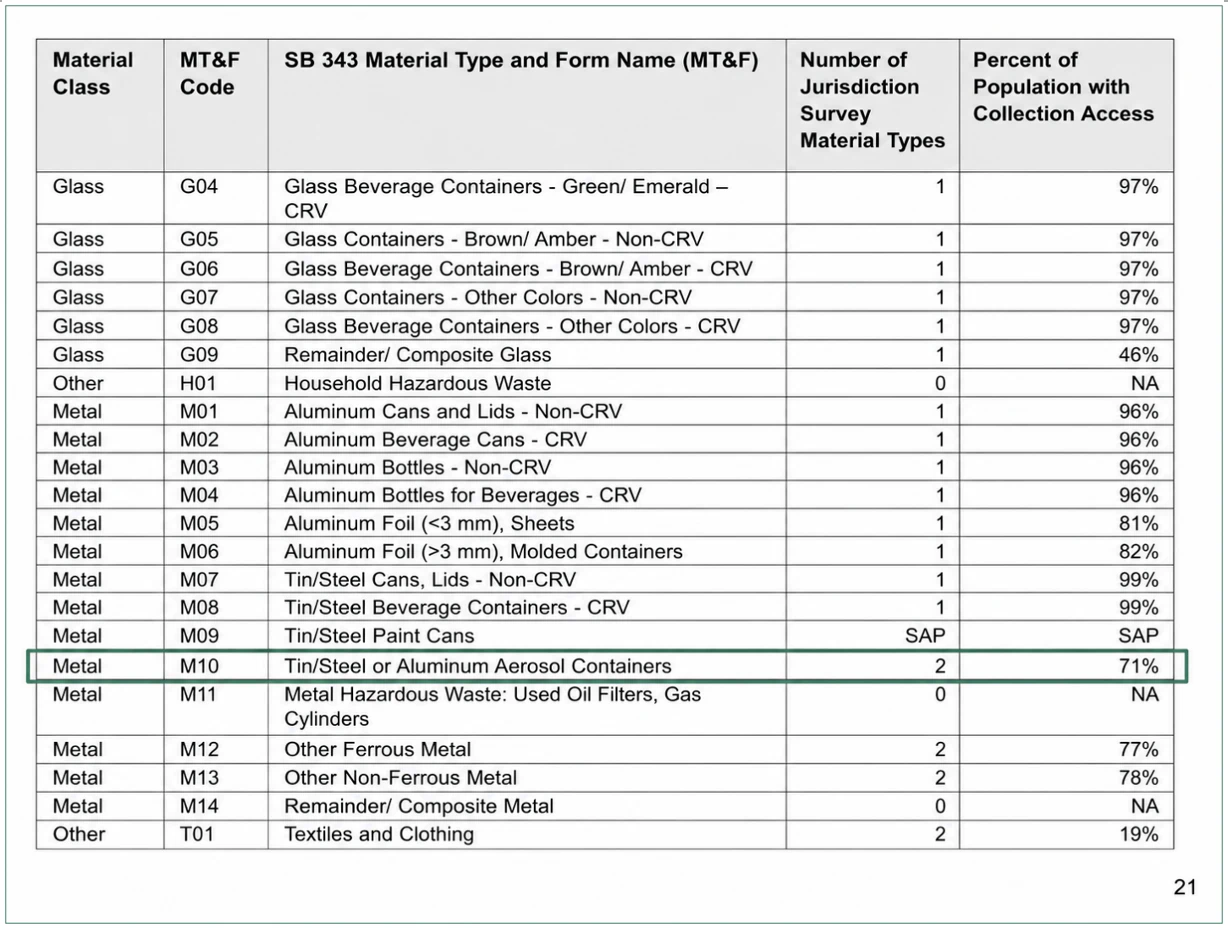
Starting at page 20, find a table titled Percentage of Statewide Population with Access to a Residential Curbside Recycling Program Which Accepts SB 343 Material Types and Forms.
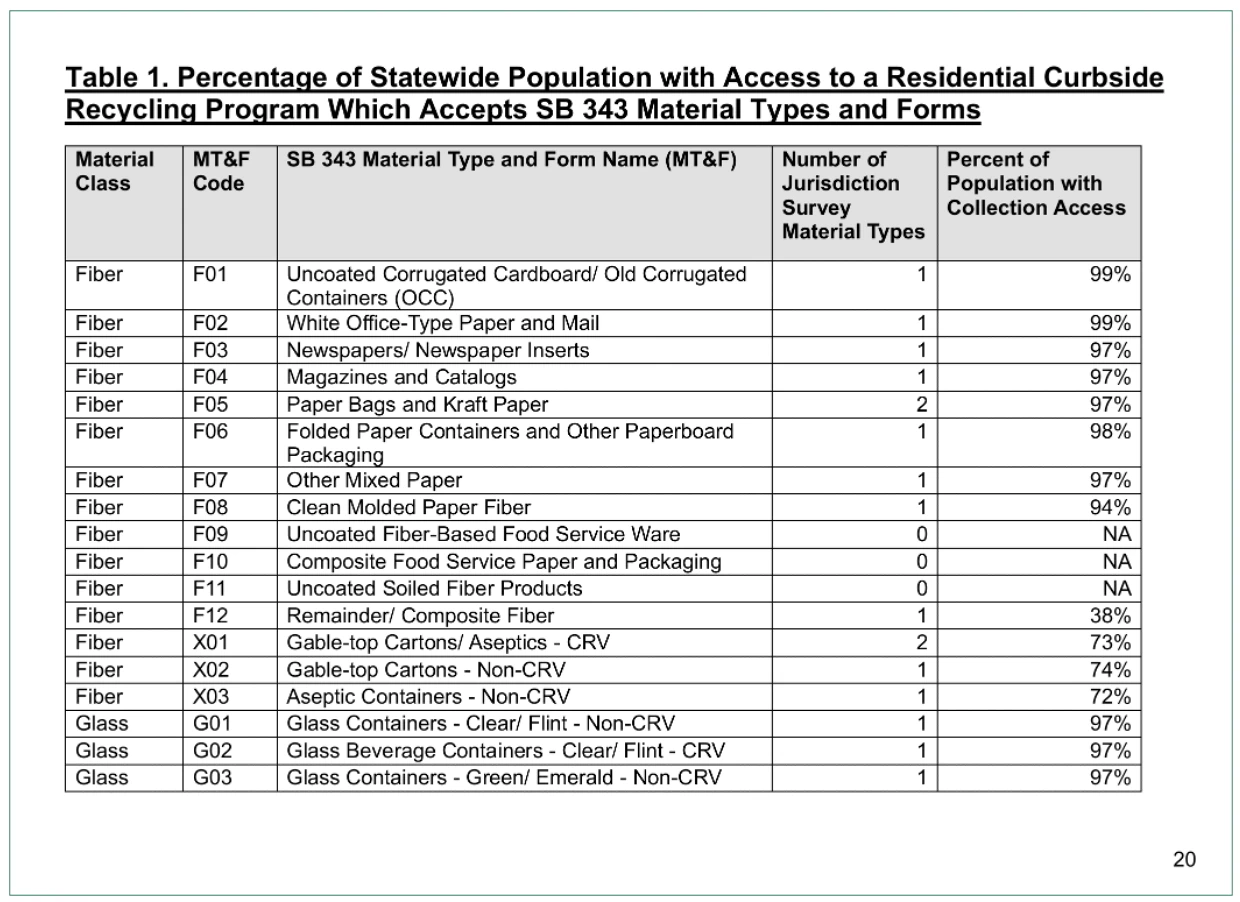
Find M10 Tin/Steel or Aluminum Aerosol Containers. As marked in the screenshot below, the percent of Population with Collection is 71%, which is greater than the 60% requirement. Therefore, Tin Aerosol cans are complied with requirement 1.
Step 2: Check Sorting and Processing Capability (≥60% Served by Statewide Recycling Programs)
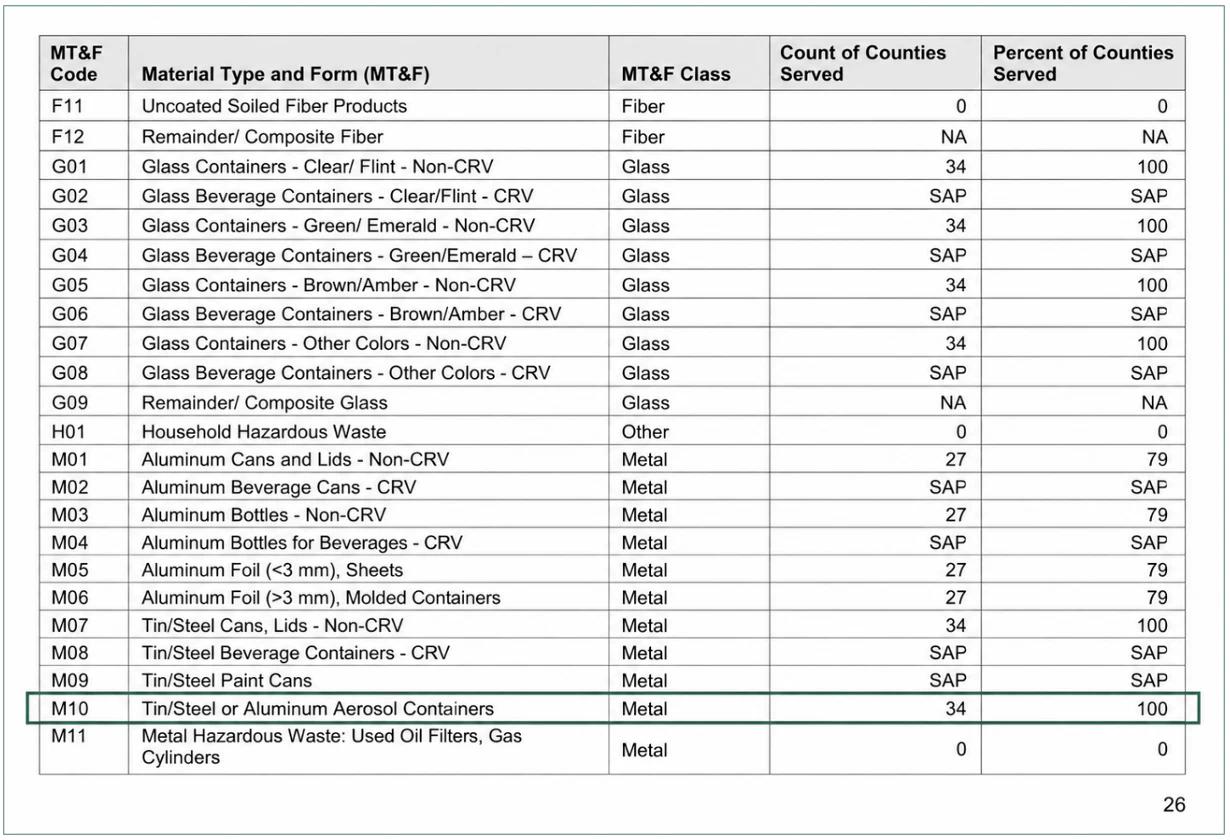
Starting at page 25, find a table titled Sorting of Material Types and Forms to All Outflows, by Counties Served by Surveyed LVTP Facilities.
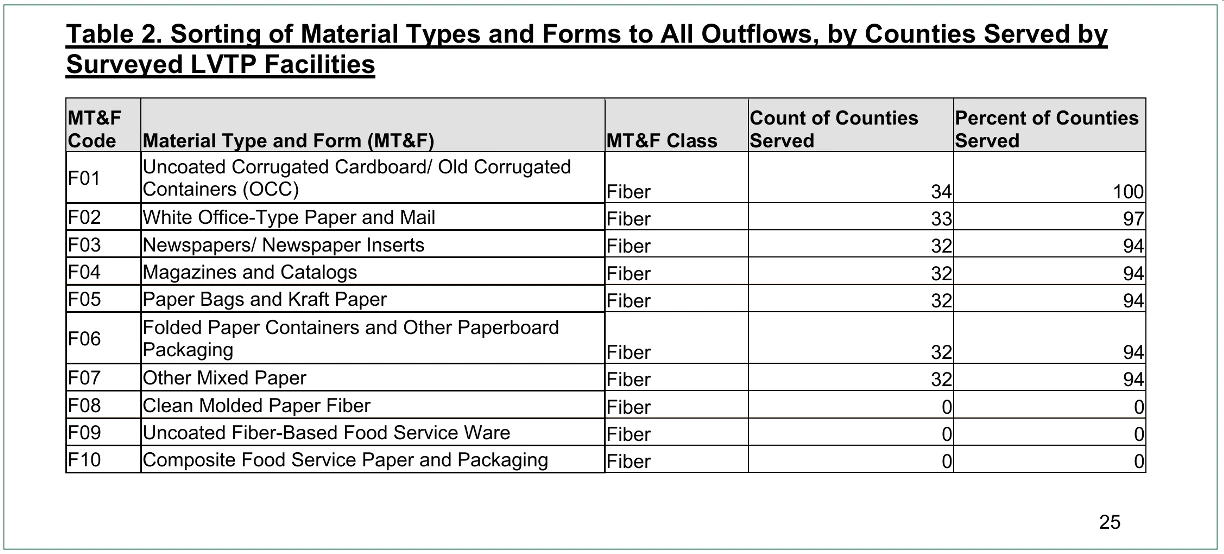
As marked in the screenshot below, 100% of Counties are served with sorting and processing capabilities for M10 Tin/Stell or Aluminum Aerosol Container. As a result, tin Aerosol Cans satisfy with the requirement that sorting & processing facilities collectively serve at least 60% of counties in the state.
Also, starting on page 35, find table 3C Material Characterization of Metal Outflows.
As shown in the figure below, M10 (Tin/Steel or Aluminum Aerosol Containers) represents a measurable portion of the recycling outflow. This indicates that the material is consistently sorted into defined recycling streams by large-volume transfer and processing facilities and is directed to reclaimers. Therefore, it satisfies Requirement 2 under SB 343 regarding sorting and reprocessing capability.

Step 3: Check Composition and Design Compliance
While SB 343 does not prescribe detailed design specifications for each individual product type, it requires that packaging does not include features that inhibit recyclability within the existing system. In practice, the design must align with how materials are collected, sorted, and reprocessed in California.
A tinplate (steel) aerosol can generally aligns well with SB 343 Requirement 3 when manufactured according to the following requirements:
- Material Stream Compatibility: Steel aerosol cans are part of the ferrous metal recycling stream, which is widely sorted using magnetic separation.
- Internal Coating: Epoxy or polymer linings are commonly used to protect contents. These coatings must:
- Burn off cleanly during the steel recycling process
- Not introduce contamination to the melt
- Valve and Actuator System: Typically includes mixed materials (plastic, rubber, metal). These components are acceptable if:
- They do not interfere with magnetic separation
- They are removed or managed during reprocessing
- Labeling and Decoration: Printed coatings or shrink sleeves should not hinder identification or create excessive residue during recycling.
Overall Assessment: When designed with compatible coatings and standard components, tin aerosol cans: 1) do not inhibit sorting or reprocessing, and 2) are consistent with existing recycling infrastructure. Therefore, they meet SB 343 Requirement 3 for composition and design compliance.
Conclusion
California SB 343 represents a shift from theoretical recyclability to proven, system-based recyclability. To make valid recyclability claims, companies must ensure their packaging meets all three core pillars:
- Collection – Broad access across the California population
- Sorting & Reprocessing – Verified flow through recycling infrastructure
- Design Compatibility – Packaging that does not disrupt existing recycling systems
For materials such as metal packaging (e.g., tinplate and aluminum aerosol cans), the pathway to compliance is generally strong due to established collection and processing systems. However, compliance is not automatic — coatings, components, and overall design must still be evaluated carefully to ensure alignment with SB 343 requirements.
From an operational perspective, SB 343 requires companies to move upstream:
- Engage suppliers earlier
- Validate material data
- Integrate recyclability into packaging design decisions
- Substantiate all labeling claims with credible data
Evergreen Resources supports this process by working closely with customers to:
- Evaluate packaging against SB 343 criteria
- Provide technical insight into material selection and design compatibility
- Align sourcing with compliant and scalable recycling solutions
By combining regulatory understanding with practical packaging expertise, Evergreen helps ensure that recyclability claims are not only compliant but also supported by real-world performance within the recycling system.
Resources
This article incorporates and summarizes information from official resources published by the California Department of Resources Recycling and Recovery (CalRecycle). The original sources are listed below for reference:
- SB 343 Material Characterization Study – Final Findings (2023/2024)
- Prepared by Cascadia Consulting Group; published by CalRecycle
- Publication Date: April 4, 2025
- Document ID: DRRR-2025-1750
- This blog references data and findings related to:
- Recycling system performance
- Material collection, sorting, and outflow (e.g., metal stream classification such as M10)
- Source available via: https://calrecycle.ca.gov/wcs/recyclinglabels/
- SB 343 Frequently Asked Questions (FAQ)
- Published by CalRecycle
- This blog references guidance on:
- Definitions of “recyclable” under SB 343
- Labeling requirements and claim limitations
- Interpretation of PRC §42355.51 criteria
- Source available via: https://calrecycle.ca.gov/wcs/recyclinglabels/
- SB 343 Recycling Labels Guidance Page
- Published by CalRecycle
- This page serves as the central resource for:
- Regulatory updates
- Supporting documentation
- Implementation guidance
- Source available via: https://calrecycle.ca.gov/wcs/recyclinglabels/