

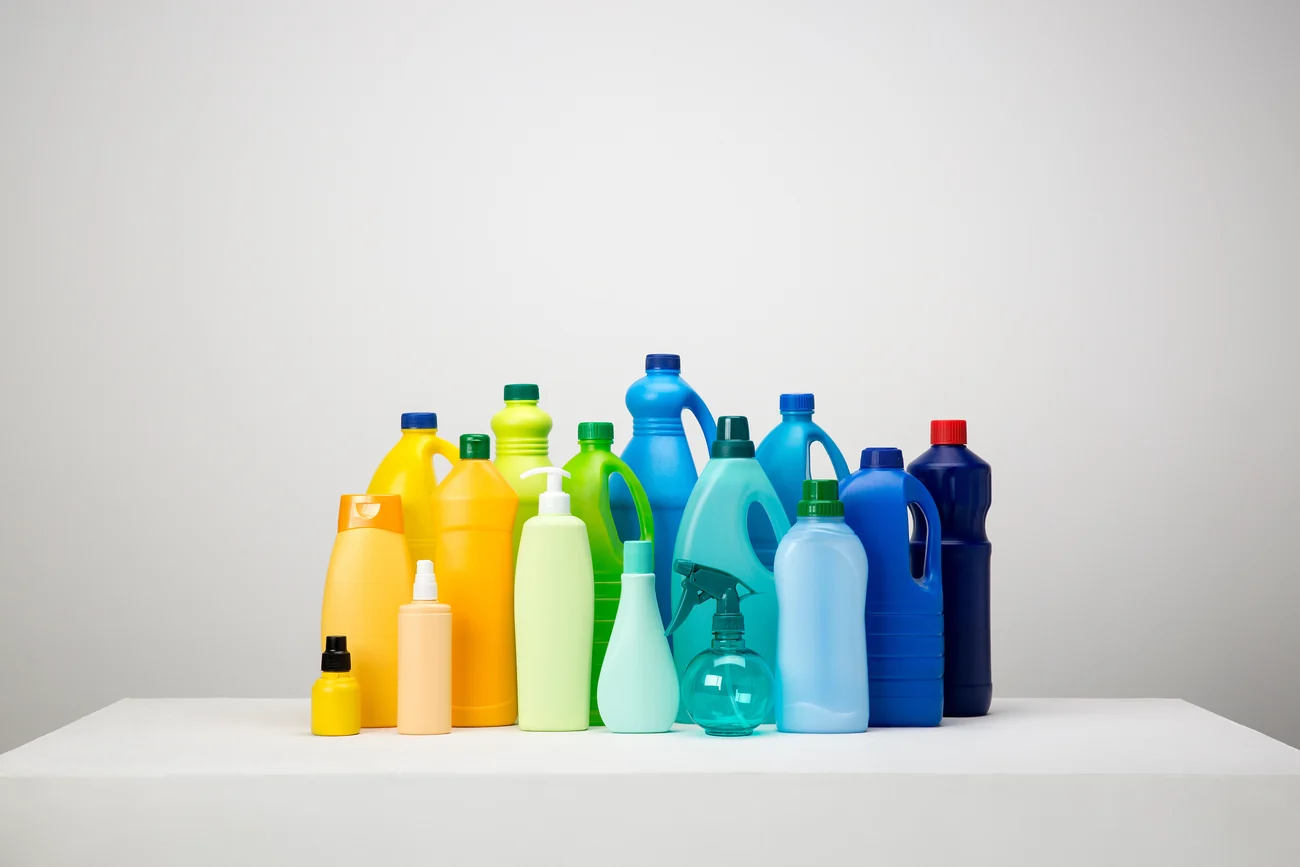
This glossary brings together commonly used plastic packaging terms and organizes them by how plastic containers are designed, formed, sealed, and evaluated. It covers key terminology for plastic bottles, jars, preforms, airless systems, dispensing components, and specialty formats.
Whether you are reviewing drawings, comparing suppliers, or troubleshooting issues, this guide helps make technical terminology easier to understand and apply.
Index
- Plastic Materials & Additives
- Manufacturing Processes
- Geometry & Structural Features
- Plastic Bottle Terminology
- Plastic Jar Terminology
- Plastic Cap Terminology
- Dispensing Systems
- Specialty Packaging
- Sealing & Barrier Systems
- Filling, Compatibility & Performance
- Surface Finishing & Decoration
- Quality & Testing
- Sustainability & Recycling
Plastic Materials & Additives
ABS (Acrylonitrile Butadiene Styrene): A rigid, impact-resistant plastic with excellent surface finish, commonly used for caps, pump components, and premium cosmetic packaging. Compared to PP, ABS offers better rigidity and appearance but lower chemical resistance, making it less suitable for aggressive formulations.
Barrier Resin (e.g., EVOH): A high-performance material used as a layer in multi-layer packaging to reduce oxygen transmission. Commonly used in food bottles, soft tubes, and chemical containers where shelf life is critical. Unlike PE or PP, it is not structural and must be combined with other materials.
Color Masterbatch: Concentrated pigments added during molding to create consistent color throughout the plastic. Unlike spray coating, the color is embedded in the material and more resistant to wear.
HDPE (High-Density Polyethylene): A strong, opaque plastic with excellent chemical resistance, widely used for detergent bottles, chemical containers, and industrial packaging. Compared to PET, it is less clear but more durable and resistant to stress cracking.
LDPE (Low-Density Polyethylene): A softer, flexible plastic used for squeeze bottles, tubes, and dispensing containers. Compared to HDPE, it offers better flexibility but lower structural strength, making it suitable for products that require manual dispensing.
Nylon (Polyamide, PA): A strong and durable plastic with excellent barrier and puncture resistance. Commonly used in multi-layer packaging, cartridges, and specialty industrial containers. Compared to PET, it provides better mechanical strength but absorbs moisture, which can affect performance.
Post-Consumer Recycled (PCR): Material made from plastic that has been used by consumers, collected, and reprocessed into new packaging, reducing reliance on virgin resin and supporting sustainability goals. It helps lower carbon footprint and meets regulatory or brand ESG requirements, improving market positioning. However, PCR may have variability in color, odor, and mechanical properties, which can affect consistency. Compared to virgin material, it may also have limitations in food-contact use, performance, and supply stability.
PET (Polyethylene Terephthalate): A clear, strong plastic commonly used for beverage bottles, personal care packaging, and food containers. Compared to HDPE or PP, PET offers superior clarity and gas barrier but lower heat resistance unless modified.
PETG (Glycol-Modified PET): A modified PET with improved impact resistance and easier processing, often used for cosmetic bottles, display packaging, and thermoformed containers. Compared to PET, it is less brittle but has slightly lower barrier performance.
Polypropylene (PP): A rigid plastic with good heat resistance and fatigue strength, commonly used for caps, closures, food containers, and dispensing systems. Compared to PE, PP performs better at higher temperatures and is ideal for hinged components such as flip top caps.
Polystyrene (PS): A rigid, transparent plastic often used for disposable cups, lids, and trays. Compared to PET, it is more brittle and less impact-resistant but easier to process and lower cost.
PVC (Polyvinyl Chloride): A versatile plastic used in blister packaging, shrink sleeves, and some flexible films. Compared to PET or PP, it offers good clarity but has more regulatory and environmental concerns, especially in food applications.
SAN (Styrene Acrylonitrile): A transparent plastic with improved chemical resistance compared to PS, used in cosmetic jars, dispensers, and personal care packaging. Compared to PET, it has lower impact resistance but good stiffness and clarity.
UV Additive: Additives used to reduce UV light penetration and protect sensitive products. Commonly used in pharmaceutical bottles, outdoor packaging, and chemical containers where light exposure may degrade the product.
Manufacturing Processes
Co-Extrusion: A process where multiple plastic materials are extruded together to form a layered structure within a single container wall. Each layer serves a different function, such as structural support, barrier protection, or chemical resistance. Compared to single-layer molding, co-extrusion improves performance but increases complexity in manufacturing and recycling.
Extrusion Blow Molding (EBM): Plastic is melted and continuously extruded into a hollow tube (called a parison), which is then captured in a mold and inflated with air to form a bottle. This process is efficient for producing containers in one step and is commonly used for HDPE bottles. Compared to injection molding, it offers less precision in neck finish and wall thickness control, but it is more suitable for large or irregular-shaped containers.
Heat-Set PET Mold: A specialized mold used to produce PET bottles that can withstand high-temperature filling processes such as hot-fill beverages. During molding, the bottle is heat conditioned to improve dimensional stability and prevent deformation when exposed to elevated temperatures. Compared to standard PET bottle molds, heat-set molds require more complex tooling and longer production cycles but enable PET packaging for products that require thermal processing.
Injection Blow Molding (IBM): A process that combines injection molding and blow molding to create hollow plastic containers with high precision and consistent wall thickness. First, a preform is injection molded around a core rod, then transferred to a blow mold where compressed air expands it into the final bottle shape. Compared to extrusion blow molding, IBM produces more accurate neck finishes and improved dimensional consistency, making it ideal for small pharmaceutical, cosmetic, and specialty bottles.
Injection Molding (IM): Molten plastic is injected into a closed mold under high pressure to form solid, detailed parts such as caps, jars, and preforms. This process provides very high precision, excellent surface finish, and tight tolerances. However, it cannot directly create hollow containers, which is why it is mainly used for components or preforms rather than finished bottles.
Injection Stretch Blow Molding (ISBM): A process used to produce high-quality plastic bottles, especially PET, by combining injection molding and stretch blow molding. First, a preform is created by injection molding; it is then reheated, stretched in both axial and radial directions, and expanded with high-pressure air into the final bottle shape. The stretching aligns the polymer chains, significantly improving strength, clarity, and barrier performance. Compared to extrusion blow molding (EBM), ISBM produces lighter, stronger containers with more uniform wall thickness, making it widely used for beverage and personal care packaging.
1-Stage Injection Stretch Blow Molding (ISBM): A variation of injection stretch blow molding where the preform is molded and blow molded in a single integrated machine without a separate reheating step. This process reduces material handling and improves process efficiency for smaller production runs or specialty bottle designs. Compared to 2-stage ISBM, it offers greater flexibility and compact equipment setup, though it typically operates at lower production speeds.
2-Stage Injection Stretch Blow Molding (TS-ISBM): A two-step variation of injection stretch blow molding where PET preforms are first injection-molded, stored or transported, and later reheated and blow molded into finished bottles. Separating the process into two stages allows for very high production efficiency, centralized preform manufacturing, and easier logistics. Compared to 1-stage ISBM, TS-ISBM is better suited for high-volume beverage production but requires additional reheating equipment and handling steps.
Thermoforming Mold: A mold used in a process where a heated plastic sheet is stretched over or into a mold and formed into shape using vacuum, pressure, or mechanical force. Thermoforming is commonly used for lightweight packaging products such as trays, clamshells, lids, and disposable containers. Compared to injection molding, thermoforming uses lower-cost tooling and faster setup times, though it generally produces thinner walls and less structurally durable parts.
| Mold Type | Suitable For | Advantages | Disadvantages |
|---|---|---|---|
| Extrusion Blow Molding (EBM) | Large bottles | Handles complex & large shapes, lower mold cost | More material waste, lower precision |
| Injection Blow Molding (IBM) | Small bottles | Precise, consistent wall thickness | Limited to small bottles, higher mold cost |
| Injection Molding (IM) | Solid parts (e.g., caps) | High precision, minimal waste | Cannot make hollow products |
| Thermoforming Mold | Thin-walled packaging / simple caps / single-use trays | Low-cost tooling, fast cycle times | Thin walls, limited durability |
| 1-Stage Injection Stretch Blow Molding (ISBM) | Specialty bottles (PET) | No preform reheating, compact setup | Lower production speed, less flexibility |
| 2-Stage Injection Stretch Blow Molding (TS-ISBM) | High-volume bottles (PET) | Mass production; preforms can be produced ahead | Requires reheating and requires 2 steps |
| Heat-Set PET Mold | Hot fill PET bottles | Can be hot filled | Expensive and requires custom mold |
Geometry & Structural Features
Base: The bottom of the container designed for stability and load distribution. Reinforced designs help prevent deformation under stacking.
Body: The main section of the container that holds product and provides structural integrity. It is also the primary area for labeling and branding.
Finish: The functional opening area including threads or sealing surfaces. This determines how the closure fits and seals the container.
Gate Location: The point where molten plastic enters the mold. This can affect appearance (visible marks) and local strength depending on placement.
Neck: The upper portion connecting the body to the closure. It must be dimensionally precise to ensure proper sealing and compatibility.
Neck Finish (Preform Stage): The threaded portion of the container formed during injection molding. Unlike the body, it is not stretched later, ensuring consistent sealing performance.
Preform: A small, injection-molded intermediate part later expanded into a bottle. It already includes the finished neck, ensuring precision and consistency in the final product.
Shoulder: The transition between the body and neck, influencing both appearance and strength. Smooth transitions help reduce stress during filling and handling.
Plastic Bottle Terminology
Graduation Mark: Measurement markings used for dosing or mixing. These can be molded into the bottle or printed on the surface depending on accuracy requirements.
Multi-Layer Bottle: A bottle made with multiple material layers for improved barrier or chemical resistance. Compared to single-layer bottles, it offers better protection but is more difficult to recycle.
Plastic Bottle: A hollow container typically made by blow molding, used for liquids. Compared to jars, bottles have narrower openings for controlled pouring or dispensing.
Squeeze Bottle: A flexible bottle that dispenses product when pressure is applied. Unlike rigid bottles, it does not require a pump or gravity to release contents.
Plastic Jar Terminology
Double Wall Jar: A jar with inner and outer layers for improved aesthetics and insulation. Compared to single-wall jars, it provides a more premium look and feel.
Plastic Jar: A wide-mouth container typically produced by injection molding. Compared to bottles, jars allow easier access for thick or solid products.
Wide-Mouth Finish: A large opening that allows easy filling and product access. It is commonly used for creams, powders, and food products.
Plastic Cap Terminology
Child-Resistant Cap (CRC): A safety closure designed to prevent access by children, typically requiring a push-and-turn or squeeze-and-turn action. Commonly used for pharmaceuticals, chemicals, and regulated products. Compared to standard caps, it improves safety but may reduce ease of use for some consumers.
Continuous Thread (CT) Cap: A screw cap with a continuous spiral thread that matches the container finish. It is one of the most common closures for bottles and jars, providing reliable resealability. Compared to snap-fit closures, it offers better sealing consistency and torque control.
Disc Top Cap: A hinged cap where pressing one side opens a small dispensing orifice. Commonly used for shampoos, lotions, and personal care products. Compared to flip-top caps, it allows one-handed operation but typically dispenses smaller amounts.
Flip-Top Cap: A cap with a hinged lid that opens and closes over a dispensing orifice. Widely used for personal care and food products. Compared to CT caps, it improves convenience but may have slightly lower sealing performance if not properly designed.
Overcap: A secondary cap placed over a primary dispensing system such as pumps or sprayers. It provides protection, cleanliness, and improved appearance but does not create the primary seal. Compared to main closures, it is not involved in sealing performance.
Push-Pull Cap: A cap with a movable nozzle that is pulled up to open and pushed down to close. Commonly used for sports drinks and dispensing bottles. Compared to flip-top caps, it allows quick access but may have higher leakage risk if not fully closed.
Snap-Fit Cap: A closure that seals by snapping onto the container without threads. It is commonly used for food containers and lightweight packaging. Compared to CT caps, it is faster to apply but provides less precise sealing and resealing control.
Spouted Cap: A cap with an extended spout designed for controlled pouring or dispensing. Commonly used for liquids such as oils, sauces, and chemicals. Compared to standard caps, it improves flow control and reduces spillage.
Tamper-Evident (TE) Cap: A cap designed with a breakable band or feature that indicates whether the package has been opened. Commonly used for beverages, food, and pharmaceuticals. Compared to non-TE caps, it enhances safety and consumer confidence.
Twist Top Cap: A cap that opens or closes by twisting the top portion to expose or cover an orifice. Often used for condiments and personal care products. Compared to push-pull caps, it provides better sealing but requires more user effort.
Dispensing Systems
Airless Bottle: A system that prevents air from entering during dispensing. Compared to standard bottles, it extends shelf life by minimizing oxidation.
Airless Pump: A dispensing system designed for controlled dosage. It works together with the piston rather than drawing product through a tube.
Dropper: A system using a pipette and bulb to dispense small amounts of liquid. Compared to pumps or sprayers, it provides precise, manual dosing and is commonly used for serums or essential oils.
Fine Mist Sprayer: A dispensing system that atomizes liquid into a very fine mist using a small pump mechanism. Compared to trigger sprayers, it delivers a softer, more controlled spray pattern and is commonly used for personal care and cosmetic products.
Orifice Reducer: A small insert placed in the container opening to control liquid flow. Compared to droppers or pumps, it is a simple and low-cost solution but offers less precision and no active dispensing mechanism.
Pipette: A tube used to draw and release liquid, typically paired with a dropper system. It can be made from glass or plastic depending on chemical compatibility and clarity requirements.
Piston: A movable internal platform that pushes product upward as it is dispensed. Unlike dip tubes, it allows nearly complete product evacuation.
Pumps: A general dispensing system that uses mechanical force to move liquid from the container through a dip tube. Compared to sprayers, pumps typically dispense product in a stream or lotion form rather than atomizing it, making them suitable for creams, soaps, and thicker liquids.
Trigger Sprayer: A dispensing system with a trigger mechanism that draws and sprays liquid in larger volumes. Compared to fine mist sprayers, it produces a coarser spray or stream and is commonly used for household and industrial cleaning products.
Vacuum Mechanism: Uses pressure difference rather than air intake to dispense product. This improves protection for sensitive formulations.
Specialty Packaging
Deodorant Stick Container: A packaging system with a screw mechanism that pushes product upward. It is designed for solid or semi-solid formulations.
Elevator Mechanism: The internal system in stick packaging (e.g., deodorant sticks) that moves the product upward during use. It typically includes a threaded spindle (screw), elevator platform (cup), and rotating base (dial). When the user turns the base, the spindle rotates while the platform is guided so it cannot rotate, forcing it to travel upward along the threads—this converts rotational motion into vertical movement.
Plastic Cartridge: A cylindrical container used with dispensing tools like caulking guns. Compared to bottles, it is designed for controlled extrusion rather than pouring.
Roll-On Bottle: A container with a rolling ball applicator that allows product to be applied directly to a surface. Compared to sprayers, it provides controlled, localized application without atomization.
Static Mixer Compatibility: The ability of a cartridge to connect with a mixing nozzle for two-component systems. This ensures proper mixing during application.
Sealing & Barrier Systems
Barrier Layer: A material layer integrated into the container wall to reduce gas or moisture transfer, commonly using materials like EVOH or Nylon. It is critical for extending shelf life, especially for oxygen- or moisture-sensitive products such as food or chemicals. Unlike liners, barrier layers are part of the container structure rather than the closure system.
Foam Liner: A compressible material placed inside the cap that creates a seal when the closure is tightened against the container finish. It is reusable and provides basic leak protection but does not create a tamper-evident seal. Compared to induction or pressure-sensitive liners, it relies only on compression rather than bonding to the container.
Induction Seal: A foil-based liner bonded to the container finish using electromagnetic induction, creating a hermetic seal. It provides strong tamper evidence, leak prevention, and extended shelf life by fully sealing the opening. Compared to foam or pressure-sensitive liners, it forms a permanent bond that must be peeled or broken after opening.
Pressure-Sensitive Liner: A liner that adheres to the container finish when the cap is applied, using pressure rather than heat. It provides light sealing and some tamper indication but is less secure than induction seals. Compared to foam liners, it bonds to the container, but the seal strength is weaker and less resistant to leakage or environmental conditions.
Filling, Compatibility & Performance
Compatibility: The interaction between product and packaging over time. Poor compatibility can lead to deformation, discoloration, or failure.
Headspace: The empty space between product and closure. It allows for expansion due to temperature or pressure changes.
Permeation: The gradual passage of gases or liquids through plastic. Unlike leaks, this occurs at a molecular level.
Stress Cracking: Cracking caused by chemical exposure and mechanical stress. It is a common failure mode in plastics.
Surface Finishing & Decoration
Color Spray (Spray Coating): Liquid paint is sprayed evenly onto the container surface to create color or special visual effects. This method allows gradients, metallic looks, or custom finishes. Compared to masterbatch coloring, spray coating is external and more flexible in appearance, but it can be more prone to scratching or wear over time. For a closer look at spray coating techniques and decorative finishes, you can explore Evergreen’s color spray page.
Embossing / Debossing: A forming process that creates raised (embossed) or recessed (debossed) features on the surface. Unlike printing, it does not add color but creates texture and visual depth, improving both aesthetics and grip. For a closer look at how these molded surface details are applied in packaging, you can explore Evergreen’s emboss & deboss page.
Flexographic Printing: A high-speed printing method using flexible plates and fast-drying inks. It is commonly used for labels, films, and continuous packaging surfaces. Compared to offset printing, flexographic printing is more efficient for large-volume production but may have slightly lower resolution. For more detail on how this process is used across labels and flexible packaging, you can explore Evergreen’s flexographic printing page.
Labeling: Labels are applied to the container using adhesive or shrink technology. This allows flexible design changes without modifying the container itself. Compared to direct printing, labeling is more adaptable but may have durability limitations depending on use conditions.
Matte / Gloss Finish: Describes the final surface reflectivity of the container. Matte finishes reduce glare and fingerprints, while gloss finishes enhance brightness and color vibrancy. The choice affects both appearance and perceived product quality. For a closer look at how these surface finishes are applied across packaging formats, you can explore Evergreen’s matte finish page.
Metallization (Vacuum Metallization): A process where a thin metal layer, usually aluminum, is deposited onto the plastic surface in a vacuum chamber. This creates a reflective, metallic finish without using solid metal. Compared to spray coating, metallization provides a more uniform and premium reflective appearance but requires additional protective top coatings. For additional detail on this process and its applications in premium packaging, you can explore Evergreen’s metallization page.
Offset Printing: Ink is transferred from a plate to a rubber blanket and then onto the container surface. This indirect method allows high-resolution, multi-color designs with fine detail. Compared to silk screen printing, offset printing supports more complex graphics but is typically applied on flat or pre-treated surfaces rather than directly on all container shapes. For a closer look at how this printing method is used across packaging formats, you can explore Evergreen’s offset printing page.
Silk Screen Printing: Ink is applied through a mesh screen directly onto the container surface. It provides thick, durable ink layers and strong color coverage. Compared to offset printing, it is better for simple designs and curved surfaces but is limited in the number of colors per print cycle. For more detail on how this method is applied to curved and cylindrical packaging formats, you can explore Evergreen’s silkscreen printing page.
Soft Touch Coating: A specialized coating applied to create a smooth, rubber-like surface feel. It enhances grip and provides a premium tactile experience. Compared to standard coatings, it focuses more on touch and user perception rather than visual appearance alone. For a closer look at how this finish is used across premium packaging applications, you can explore Evergreen’s soft touch page.
Water Transfer Printing: A process where printed patterns are transferred onto the container using a water film. The container is dipped into water where the pattern wraps around complex shapes. Compared to direct printing methods, it allows full-surface and irregular shape decoration but involves more processing steps. For additional detail on how this technique is used for complex shapes and full-surface decoration, you can explore Evergreen’s water transfer page.
Quality & Testing
Drop Test: Evaluates the container’s ability to withstand impact during handling and transport. It simulates real-world shipping conditions.
Leak Test: Detects whether the package prevents liquid or air escape. It ensures seal integrity and product safety.
Top Load Test: Measures resistance to vertical compression. It is important for stacking strength during storage and shipping.
Torque Test: Measures the force required to open or close a cap. Proper torque ensures both sealing performance and user convenience.
Sustainability & Recycling
Lightweighting: Reducing material usage while maintaining performance. This lowers cost and environmental impact.
Mono-Material Design: Packaging made from a single material type. Compared to multi-material or multi-layer structures, it is easier to recycle.
Resin Identification Code (RIC): A numbering system (1–7) used to identify plastic types and support sorting in recycling processes, where #1 is PET, #2 is HDPE, #3 is PVC, #4 is LDPE, #5 is PP, #6 is PS, and #7 represents Other plastics, including materials such as polycarbonate, bioplastics, and multi-layer resins.
Conclusion
Understanding plastic packaging terminology is important because these terms directly affect how a package is designed, manufactured, filled, and evaluated. Across bottles, jars, airless systems, and specialty formats, differences in materials, structure, and processes can significantly impact performance, compatibility, and user experience.
A clear understanding of these terms helps improve communication across sourcing, engineering, quality, and production teams, and supports better decision-making when comparing suppliers or developing new packaging. At Evergreen, we work closely with both suppliers and customers to ensure packaging specifications are clearly defined and consistently executed across the supply chain. To learn more, check out our Plastic Packaging Portfolio or complete a project intake form to Get Started.