

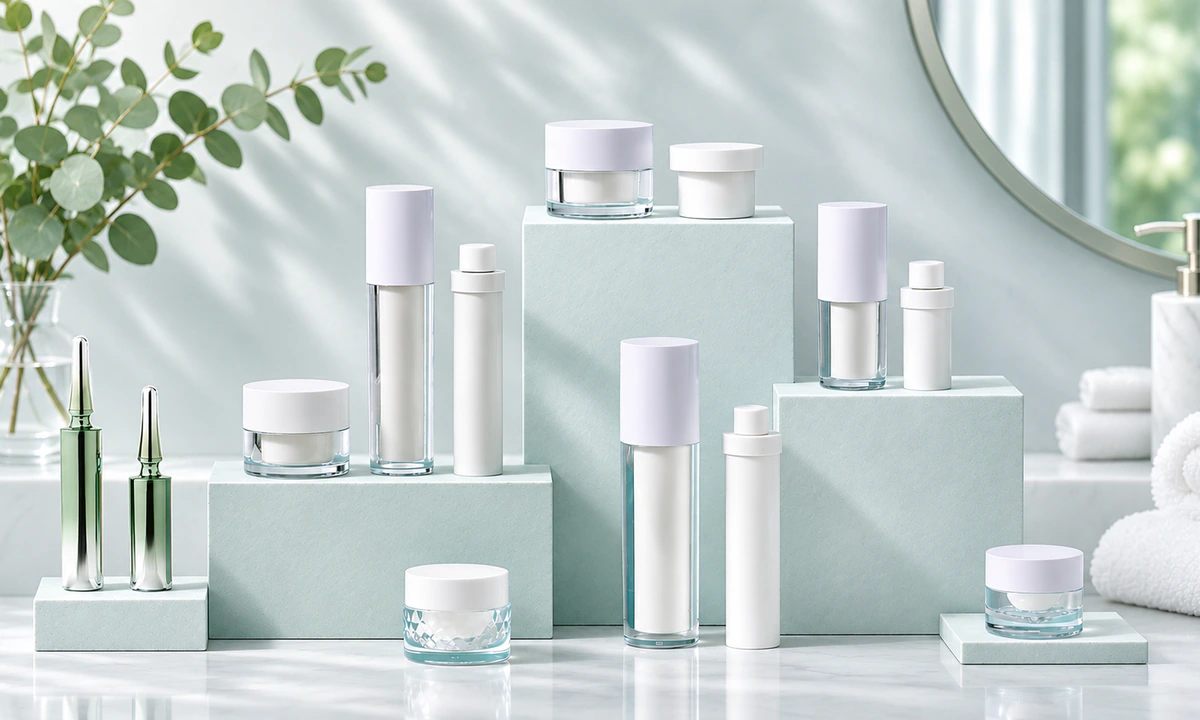
A refillable package is only as sustainable as the refills people actually buy. Refill works as a system — a durable primary worth keeping, a refill that’s cheaper and cleaner to use, a product people rebuy often, and refills sold where they already shop. When one of those parts breaks, the “refillable” package becomes a heavier single-use package.
That’s why refill succeeds in some categories and stalls in others. Below, we break down the math that decides whether refill pays off, where it works in beauty, home care, and food, and the four format pairs that hold up in practice.
Refill Is a System, Not a Package
This post covers refill at home: the consumer keeps a durable primary and buys separately sold refills. That's different from returnable models, where the brand collects, cleans, and refills the package. The distinctions between these models are further explained in our Sustainable Packaging Terminology guide.
A refill-at-home system has four parts, and all four have to work:
- Durable primary: It needs a real job — a pump, sprayer, twist-up mechanism, or a decorated shell people want on the counter — and it has to survive repeated use.
- Refill format: It should use as little material as possible, ideally a single material, and fit the primary without leaks or mess.
- Consumer behavior: People have to actually refill, and keep refilling.
- Economics: The refill has to cost clearly less than the full pack, and the brand has to recover the cost of the primary over repeat orders.
The Ellen MacArthur Foundation builds the same logic into how it measures reuse. A keeper container has to serve an essential function, such as a dispenser, spray cap, or twist-up base, and refill volume has to clearly outstrip the primary before it counts.
The Math That Decides Whether Refill Pays Off
Refill Rate Beats Package Design
The number that matters most is how many people actually buy refills. The Sustainable Packaging Coalition shows how refill rate translates into uses per primary:
| Refill rate | Average uses per primary |
|---|---|
| 50% | 2 |
| 70% | 3.3 |
| 80% | 5 |
| 90% | 10 |
Even a 70% refill rate means the average primary is used only about three times. The Ellen MacArthur Foundation puts the risk plainly: offering refills doesn't guarantee that many consumers buy them, and when they don't, the keeper container is effectively single-use.
Heavier Primaries Need More Refills
Durable primaries start with a larger footprint than single-use packs, because durability makes them heavier. That footprint pays back only as it's spread across refills, and the heavier the primary, the more refills it takes. A decorated glass or aluminum primary reads as premium, but it needs more refills to earn its keep than a lighter plastic one.
The refill format matters, too. One peer-reviewed life cycle study of a detergent refill system found that a single refill cut packaging-related impacts by about 35% on average, and five refills by about 60%. It also found that a virgin-plastic refill pouch limited the system's circularity gains, a trade-off recycled content would help address.
When the Refill Costs Nearly as Much as the Full Pack
Consumer research consistently finds that shoppers expect refills to cost less than the original. When the refill isn't meaningfully cheaper, they rebuy the full pack or switch brands.
The brand side has its own math. A refill that carries its own mechanism, such as a cartridge with a twist-up base, can cost close to what the full pack does. Practitioners report that refillable cartridge systems often take three to four orders before costs balance out with the original packaging. That's why the refill should carry as little packaging as possible, and why many brands sell refills at a lower price point or through subscriptions.
Why Adoption Trails Interest
Stated interest in refill consistently runs ahead of behavior. The barriers are practical:
- Availability: Refills aren't sold where the primary is, or shoppers can't find them.
- Convenience: People forget to buy refills until the primary is empty.
- Mess: Spills and messy transfers turn a quick task into a chore.
- Price: A refill priced close to the full pack removes the reason to switch.
Category matters, too. Innova Market Insights has described refillable packaging in food and beverage as still a niche, best suited to specific products such as dry goods. Personal care pouch refills are the clearest exception: in Europe, refill pouches for shower, hair, and hand care have become a common purchase.
Where Refill Works — and Where It Fails
Refill tends to work when:
- The product is bought often, so refills come around quickly.
- The primary has a job or display value: a dispenser, sprayer, twist-up case, or compact.
- The refill is clearly cheaper than the full pack.
- Refilling is quick and clean.
- Refills are sold where the primary is.
It tends to fail when the product is rarely rebought or costs little, the refill is priced near the full pack or needs its own mechanism, refilling is messy, or the product is hygiene-sensitive and has to be poured into an open container.
| Category | Where refill works | Where it struggles |
|---|---|---|
| Beauty and personal care | Pouch refills into pump bottles for body wash, shampoo, and hand soap; refillable lipsticks, compacts, and deodorant cases; sealed skincare pods and airless cartridges | Infrequently rebought products such as many fragrances |
| Home care | Concentrates and tablets mixed into a durable spray bottle; hand and dish soap refills for a counter-worthy dispenser | Very low-cost products where the refill saves pennies; refill stations that require carrying containers |
| Food | Dry goods such as coffee, tea, spices, and grains | Wet, perishable, or allergen-sensitive foods; low-value condiments; containers consumers have to clean |
Four Format Pairs That Work
| Format pair | Best fit | Main win | Main drawback |
|---|---|---|---|
| Refillable stick | Deodorant, lipstick, balm | The case provides the twist-up mechanism | Refill cartridges can be complex and multi-material |
| Pods for jars & compacts | Prestige creams, compacts | The decorated outer stays; the refill is small | The inner is still rigid; a heavy outer raises the break-even |
| Pouch into bottle | Body wash, shampoo, hand and dish soap | Large cuts in material and freight | Spills during refilling; pouch recyclability |
| Concentrate into durable bottle | Surface cleaners, hand soap | Stops shipping water | Dilution errors; formulation stability |
Refillable Sticks
A durable case carries the twist-up mechanism, and the refill is a cartridge or bullet that clicks into place. Because the case does the mechanical work, it passes the essential-function test, and daily use drives frequent refills. The catch is that some refill cartridges carry their own mechanism or several materials, which erodes the savings and complicates recycling. Keep the refill as simple as possible, and key it to the case so it fits every time. Evergreen offers refillable stick formats from 15 to 100 grams. For more details on materials and available formats, see our blog post on Stick Packaging in Personal Care.
Pods for Jars & Compacts
A decorated outer jar or compact holds a removable inner cup, so consumers replace only the part that touches the product. This suits prestige creams and pressed powders, where the outer pack carries the brand. There are two honest limits: the inner cup is still a rigid component, so the savings are smaller than with a pouch, and a heavy glass outer needs more refills to pay back. Open jars expose products to air and direct contact, while refillable airless bottles with sealed, replaceable cartridges offer an alternative for contamination-sensitive formulations. For more packaging solutions, see our blog post on 18 Personal Care Packaging Innovations.
Pouches Into Bottles
A spouted pouch or larger refill bottle tops up a durable pump or spray bottle, cutting material and freight substantially compared with buying a new rigid bottle. It's also one of the most familiar refill behaviors in personal care. The trade-offs are mess during refilling and the pouch's own end of life: multilayer barrier pouches are rarely accepted in curbside recycling, so mono-material PE and recycled content are worth specifying where the formula allows. For available options, see our Flexible Packaging Page and read our blog post on Making Plastic More Sustainable for additional insights.
Concentrates
A small concentrate bottle, tablet, or sachet is mixed with tap water in a durable spray bottle, so the brand stops shipping water. Dual dip tube trigger systems take the idea further by drawing concentrate and water at a controlled ratio as the product sprays, an approach we covered in our Innovations in Dispensing blog post, though holding that ratio is demanding engineering. The risks are dilution errors and formulation stability. And a concentrate that needs no keeper bottle is a "reduce" strategy, not refill.
Designing the System: What to Specify
- A primary built for repeat use. Choose the material by weight and expected refills, qualify it for drops, wear, and cleaning, and specify decoration that holds up to repeated handling. Design it for recycling at end of life, too.
- A keyed refill fit. Design the refill and primary together, whether snap, thread, or lock-and-key, so refills seat reliably.
- Sealed swaps over open pours. Cartridge, pod, and spouted-pouch transfers limit mess and contamination compared with pouring into an open container.
- Labels on the refill. Required product information has to travel with the refill, not just the primary.
- Compatibility on both halves. Test the formula against the primary and the refill material, including the refill's own shelf life.
Evergreen's refillable packaging is tested for durability, seal integrity, and material compatibility across repeated use cycles, with QC engineers onsite for every production run.
How to Tell If a Refill Program Is Working
- Refill attach rate: the share of primary buyers who buy a refill, and keep buying.
- Refills per primary: convert refill rate into average uses with the table above.
- Refill volume vs. primary volume: refills should clearly outstrip the primary.
- Material and freight saved per use: grams of packaging per unit of product delivered.
- Refill price vs. full pack: the gap has to be big enough to change behavior.
If refill purchases aren't tracked, the sustainability claim isn't supported.
Building a Refill System That Pays Off
Refill isn't a product; it's a commitment to a system. Start with categories people rebuy often, design a primary worth keeping and a refill that's cheaper, cleaner, and easy to find, then measure whether refills actually happen.
Evergreen supplies refillable jars, airless bottles, sticks, and pouches, so both halves of the system can be sourced, decorated, and qualified together. Explore our Refillable Packaging Page or get in touch with our team.