

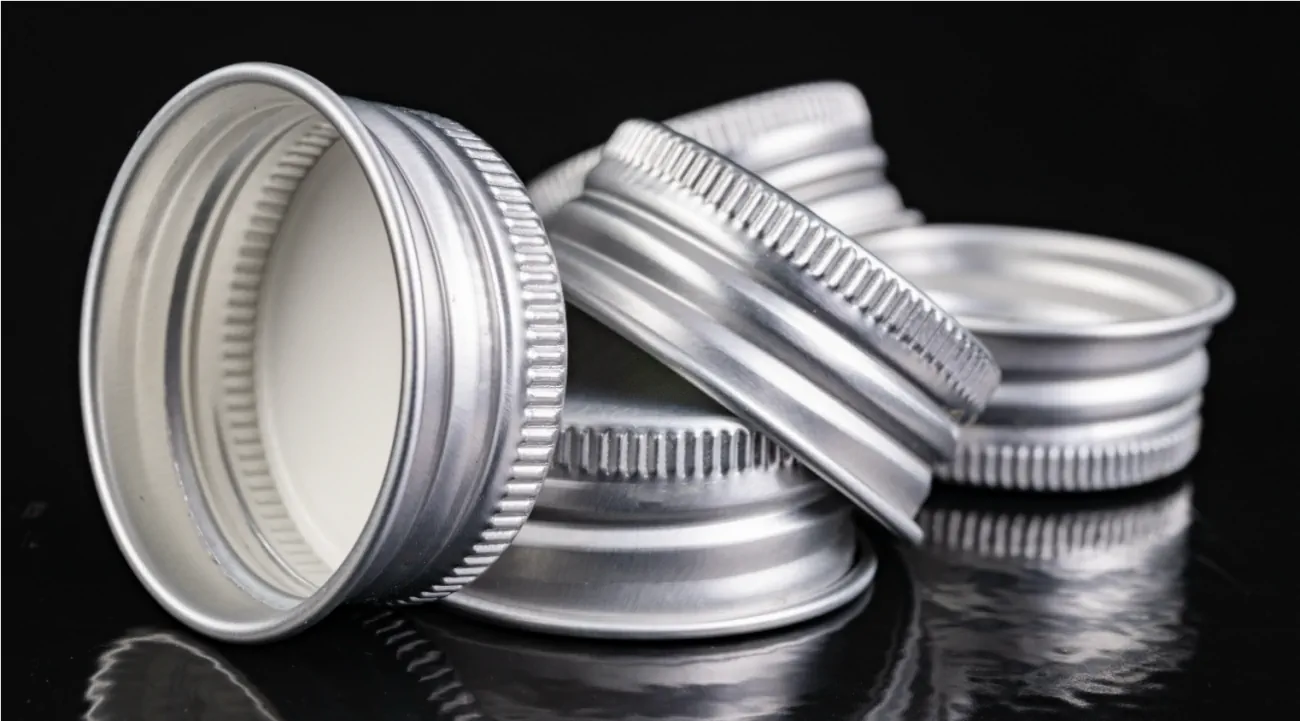
This guide provides a structured overview of the primary metal closure types used with glass containers. It explains how each closure functions, where it is typically applied, and how sealing mechanisms — such as liner compression, thread engagement, crimping, or roll-on forming — interact with glass neck finishes. The guide also highlights key dimensional and compatibility considerations, including thread series, finish geometry, torque control, and vacuum performance. The objective is to support packaging and quality teams in evaluating metal closure systems systematically and minimizing risks related to leakage, vacuum loss, torque instability, corrosion exposure, and consumer dissatisfaction.
Metal Closure Types
Metal closures are typically manufactured from aluminum or tinplate and are widely used in food, beverage, and pharmaceutical glass packaging where sealing reliability and shelf stability are critical.
Key Characteristics
- Strong barrier against oxygen, moisture, and light
- Excellent torque retention and vacuum-hold capability
- High heat resistance, suitable for hot-fill, pasteurization, and retort processes
Lug (Twist-Off) Caps

Metal lug (twist-off) caps are metal closures with interrupted thread segments (“lugs”) that engage matching glass thread ramps with a short rotational motion, typically a quarter turn. They are designed primarily for hot-fill and vacuum-sealed glass packaging, where liner compression and panel flexibility work together to create a hermetic seal. Lug caps are widely used for shelf-stable food products requiring reliable vacuum retention and tamper evidence.
- Diameters: 30 mm, 38 mm, 43 mm, 53 mm, 58 mm, 63 mm, 66 mm, 70 mm, 77 mm, 82 mm, 100 mm
- Types: RTO, RTB, RTS, RTSF, RSB, MTO, DWO, DWB, RTP. For a detailed description of each, please see our guide on Lug Caps for Food Products
-
Profile Formats:
- Regular profile (standard skirt height)
- Mid profile (medium skirt height for taller finishes)
- Deep profile (extended skirt for tall jars or higher vacuum applications)
- Liner Options: Plastisol, BPA-NI, and PVC-Free. Seal is created by plastisol compound compression against the glass sealing surface during cooling.
- Safety Button: A safety button may be added to the center of the cap to provide a visual confirmation of vacuum sealing.
Metal Continuous Thread (CT) Caps
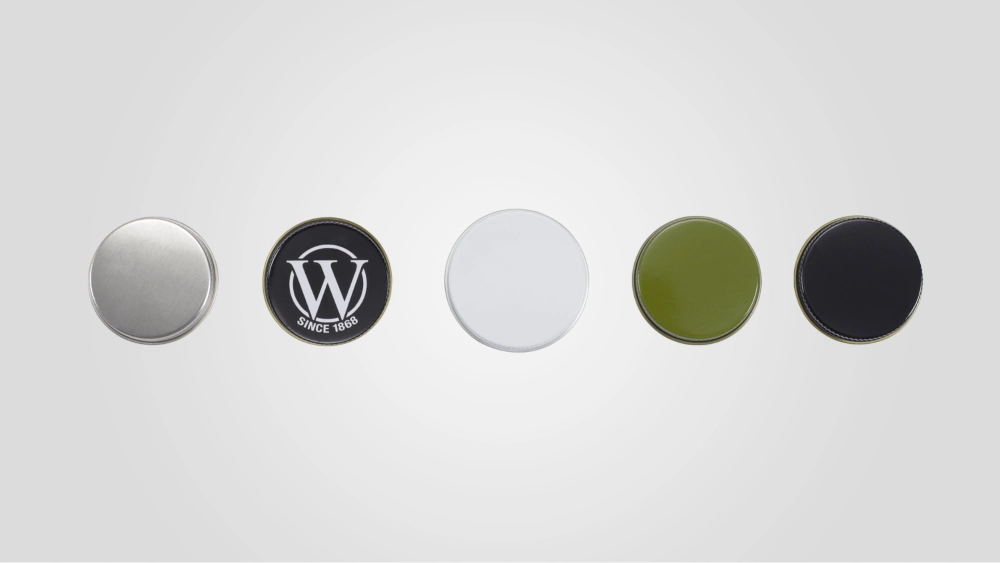
Metal continuous thread (CT) caps are screw-on metal closures with a continuous internal thread that engages the glass bottle finish to apply consistent downward force. They rely on liner compression to create the seal and are commonly used for reclosable packaging across food, pharmaceutical, and specialty applications.
- Diameters: 18 mm, 20 mm, 24 mm, 28 mm, 33 mm, 38 mm, 45 mm, 70–89 mm
- Thread Series:
- 400 series (single-turn thread)
- 410 series (taller 1.5-turn thread profile)
- Liner Options: foam liner, induction seal liner, pulp/poly liner, and plastisol compound liners in large-diameter, jar-style CT caps. Seal is created by liner compression against the glass finish.
Roll-On Pilfer-Proof (ROPP) Aluminum Caps

Roll-on pilfer-proof (ROPP) aluminum caps are closures that form threads during application by rolling onto a smooth glass neck finish. They provide tamper evidence and a secure seal, and are commonly used for wine, spirits, syrups, and other beverage applications.
- Diameters: 18 mm, 20 mm, 25 mm, 28 mm, 30 mm, 31.5 mm
- Heights:
- 18×12 mm (miniature bottles, pharmaceuticals)
- 28×15 mm (wine and spirits – industry standard)
- 30×35 mm (premium spirits and oils)
- Thread Profiles: ROPP caps are produced and shipped without threads. Threads are formed during capping when the cap is applied to the bottle neck, requiring precise neck finish geometry.
Crown Caps
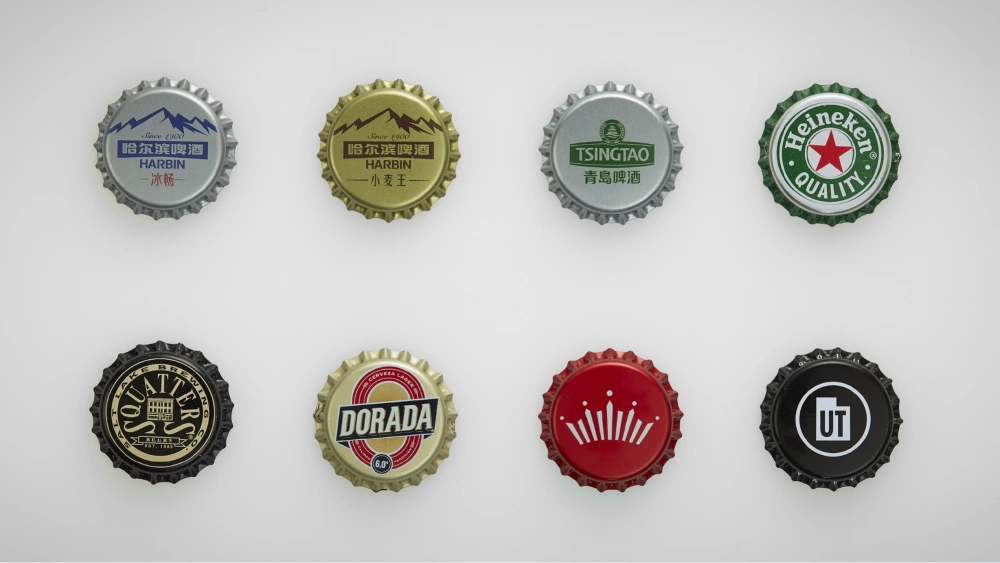
Crown caps are metal closures that are crimped onto a glass bottle finish and seal against a molded glass bead rather than threads. They are primarily used for carbonated beverages, providing strong pressure retention and tamper evidence but limited resealability.
- Standard Size: 26 mm
- Types: Pry-off and twist-off
- Sealing: Crown caps seal against a molded glass bead rather than a flat sealing surface
Closure’s Role in Glass Packaging
In glass packaging, the closure provides the mechanical structure that secures the package and applies the force required to create a seal. It controls thread engagement, application torque, tamper evidence, and overall package integrity during distribution and use. Because glass neck finishes must align precisely with the closure design, dimensional accuracy and correct thread matching are critical to ensure consistent performance.
Key risks associated with poor closure compatibility include:
- Leaks during distribution or thermal cycling
- Loss of vacuum or carbonation
- Premature product degradation
- Application issues on filling lines
- Consumer complaints related to opening or resealing
Addressing closure compatibility early in the packaging design process significantly reduces these risks. When it comes to glass packaging, metal closures are typically selected when vacuum retention, tamper evidence, and long-term shelf stability are primary requirements. Their structural strength, barrier properties, and heat resistance make them well-suited for hot-fill, pasteurization, retort, and pressure-sensitive applications. However, performance ultimately depends on proper alignment between the closure design, liner system, and glass neck finish. Careful evaluation of thread geometry, torque control, and compound compatibility is essential to ensure consistent sealing integrity throughout production, distribution, and consumer use.
FAQ
1. What are the main types of metal closures used with glass containers?
The primary metal closure types for glass packaging include lug (twist-off) caps, metal continuous thread (CT) caps, roll-on pilfer-proof (ROPP) aluminum caps, and crown caps. Each type uses a different sealing mechanism—such as liner compression, interrupted lugs, roll-formed threads, or crimped beads—and must be carefully matched to the glass neck finish. At Evergreen, we help packaging teams evaluate these options based on product type, processing conditions, and performance expectations. To learn more, check out Evergreen’s metal cap portfolio.
2. How do I choose between lug caps and metal continuous thread (CT) caps?
Lug caps are typically used for hot-fill and vacuum-sealed food products, where plastisol compound compression and vacuum panel design create a hermetic seal. Metal CT caps are better suited for reclosable applications and rely on continuous thread engagement with liner compression. The decision depends on whether vacuum retention or resealability is the priority. Evergreen works closely with customers to align closure style with processing method and shelf-life requirements.
3. What thread series are available for metal CT caps (400 vs 410)?
Metal CT caps commonly follow 400 or 410 thread series standards. The 400 series features a single-turn thread, while the 410 series has a taller, approximately 1.5-turn thread profile that provides increased engagement and potentially improved torque retention. Proper finish matching is critical to avoid cross-threading, torque instability, or sealing failure.
4. How does a ROPP aluminum cap create a seal on a glass bottle?
ROPP (Roll-On Pilfer-Proof) caps form their threads during application. A smooth glass neck finish is required, and specialized rolling equipment shapes the aluminum shell to match the bottle’s neck opening. The seal is created through liner compression and thread formation during capping. Because threads are formed in real time, tight dimensional control of the glass finish is essential—something Evergreen evaluates carefully during product qualification.
5. What are common diameters for metal lug caps and CT caps?
Lug caps are commonly available in diameters such as 38 mm, 53 mm, 63 mm, 66 mm, 70 mm, 77 mm, and 82 mm. Metal CT caps range from small beverage finishes like 18 mm and 28 mm to larger 70–89 mm jar-style closures. Selecting the correct nominal diameter is only the first step; thread geometry and finish tolerances must also align to ensure sealing reliability.
6. What liner materials are used in metal closures?
Common liner options include PVC plastisol, BPA-NI plastisol, PVC-free compounds, foam liners, faced-foam liners, induction seal liners, and pulp/poly liners. The liner selection impacts vacuum performance, oxygen barrier properties, heat resistance, and regulatory compliance. Evergreen evaluates liner compatibility based on product chemistry, fill temperature, and required shelf life.
7. What problems can result from poor closure and glass finish compatibility?
Incorrect closure and finish matching can lead to leakage during distribution, vacuum loss after cooling, inconsistent torque application, liner damage, corrosion exposure, and consumer complaints. In carbonated products, improper sealing can result in pressure loss. Addressing compatibility early in the packaging design stage—an approach Evergreen emphasizes—helps reduce these downstream risks.
8. Are metal closures suitable for hot-fill, pasteurization, or retort processes?
Yes. Many metal closures offer high heat resistance and are compatible with hot-fill and pasteurization processes, and certain designs can support retort applications when properly specified. However, compound formulation, coating integrity, and torque control must be validated to prevent liner breakdown or corrosion. Evergreen supports validation testing to ensure performance under real production conditions.