

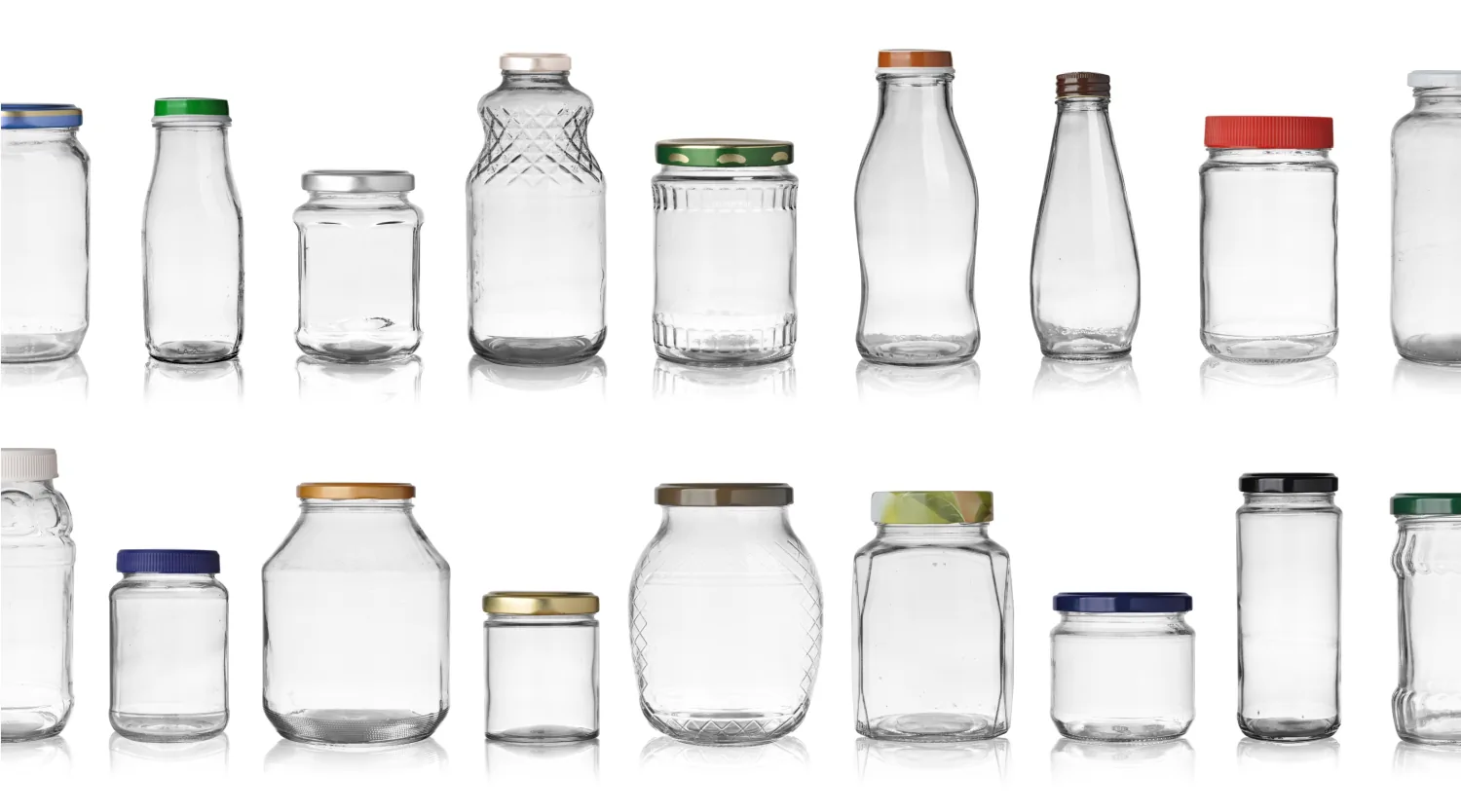
This guide provides a structured overview of glass bottle neck finish dimensions that define closure compatibility. It explains critical measurements such as T, E, I, S, and H; outlines differences between common thread series like 400 and 410; and reviews how GPI standards control tolerances across suppliers. The objective is to help packaging teams understand glass bottle neck finish geometry clearly and prevent downstream issues related to leakage, torque inconsistency, or improper closure engagement.
Understanding Neck Finish Dimensions
The interface between the closure thread and the glass finish is one of the most critical factors in sealing performance. Even when the correct nominal cap size is selected, mismatched thread profiles, incorrect finish dimensions, or tolerance stacking can prevent proper liner compression and lead to leakage, inconsistent torque, or application problems on the filling line. Understanding how thread geometry and finish dimensions work together is essential for ensuring consistent sealing, reliable production performance, and long-term package integrity.
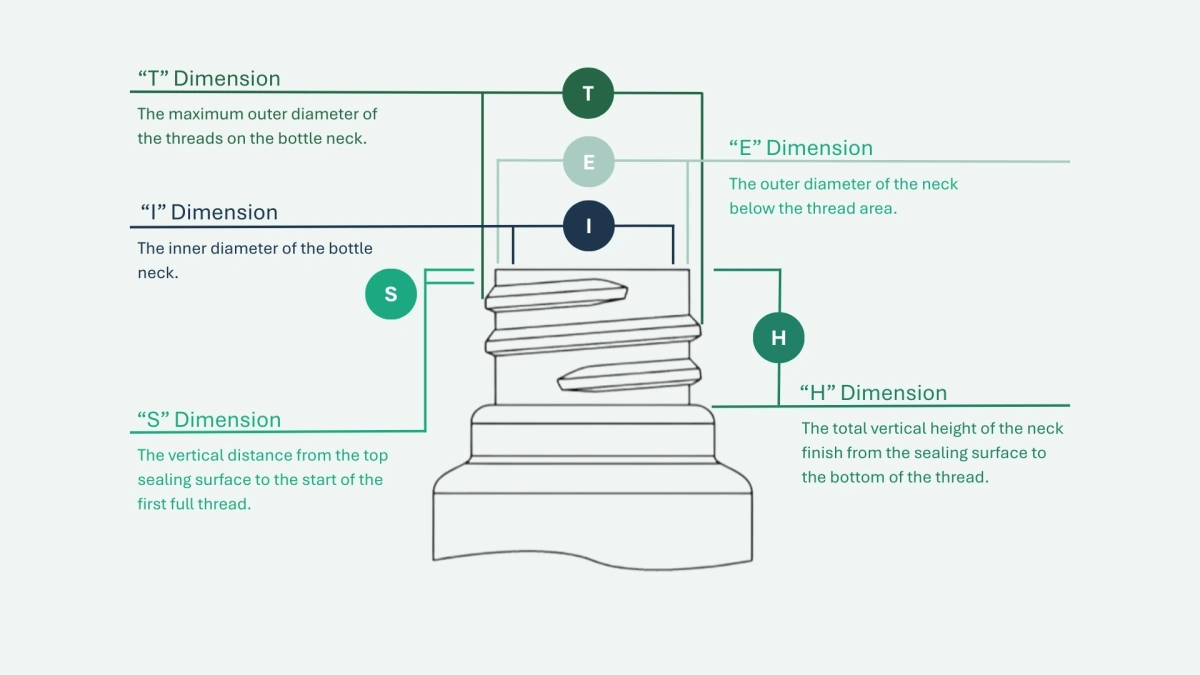
Key Dimensions to Understand:
The critical dimensions of a glass bottle neck finish are defined by GPI (Glass Packaging Institute) standards. The most important specs related to compatibility include T, E, S, and H, along with thread pitch and profile.
- Thread Diameter (T): The maximum outer diameter of the threads on the glass finish. The T dimension must match the internal thread diameter of the cap. If too large, the cap may bind or fail to apply fully; if too small, the cap may feel loose and fail to generate sufficient liner compression.
- Outside Diameter (E): The outer diameter of the neck below the thread area. The E dimension determines thread depth and affects how securely the cap engages the neck. It also influences alignment and torque consistency. If E is out of tolerance, thread engagement may be unstable, leading to cross-threading, uneven compression, or inconsistent sealing performance.
- Inner Diameter (I): The inside opening diameter of the bottle finish, measured at the bore of the neck. The I dimension determines the effective product flow area and influences filling efficiency, pour characteristics, and compatibility with inserts such as droppers, orifice reducers, or fitments. If I is out of tolerance, filling performance may be inconsistent, inserts may not seat properly, or flow control components may fail to function as intended.
- Thread Start Position (S): The vertical distance from the top sealing surface to the start of the first full thread. The S dimension controls where the cap begins engaging the threads and directly affects final seating height. If S is incorrect, the liner may be over-compressed or under-compressed, resulting in seal failure.
- Finish Height (H): The total vertical height of the neck finish from the sealing surface to the bottom of the thread. The H determines how far the closure skirt covers the neck and influences final torque and liner compression. Incorrect H dimensions may cause improper seating or visible closure misalignment.
-
Thread Profile and Pitch: The thread profile is the shape and geometry of the thread (angle, crest, root, and depth). The thread pitch is the vertical distance between thread peaks. Thread pitch and profile determine:
- The number of rotations required to close
- The vertical travel of the cap
- The distribution of compression force on the liner
Common thread profiles include: 400 (1 threaded turn), 410 (1.5 threaded turn), 415 (2 threaded turns), and 2000 (lug finish, non-continuous threads). See below for a comparison of thread series 400 vs. 410.
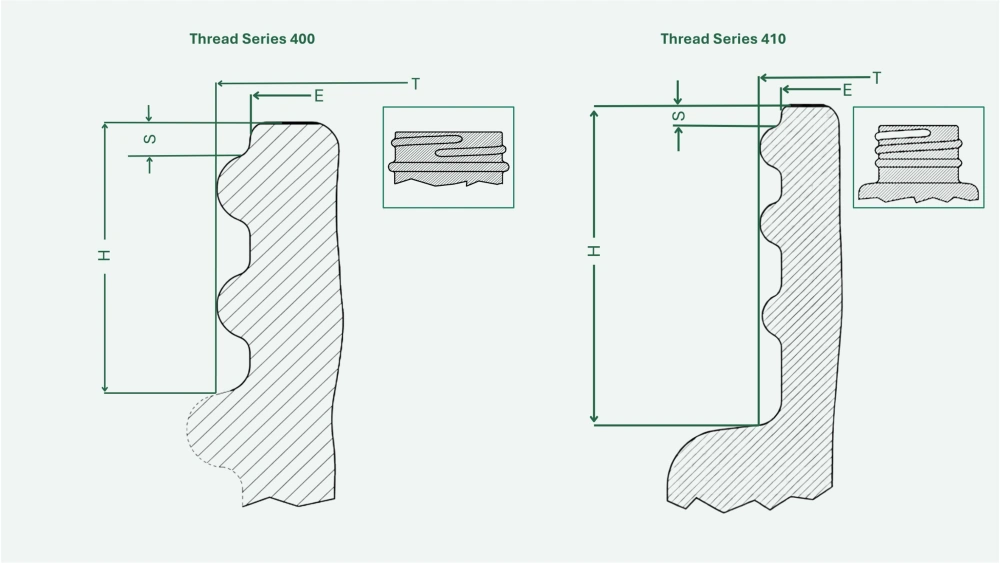
To give a practical example: when you see a thread finish of 24-410: this code defines both the diameter and the thread profile of the glass bottle neck. 24 indicates a nominal thread diameter of approximately 24 mm. 410 identifies the thread series, meaning a 1.5-turn, taller thread profile compared to the 400 series, providing greater vertical thread engagement and additional travel during cap application.
Standard GPI Sizes and Tolerances
GPI (Glass Packaging Institute) standards define the dimensional requirements and allowable tolerances for common glass neck finishes used in North America. These standards establish consistent specifications for key dimensions such as T (thread diameter), E (neck outside diameter), S (thread start), and H (finish height), ensuring that bottles and closures from different manufacturers can function together reliably. By controlling both nominal sizes and tolerances, GPI standards help maintain proper thread engagement, liner compression, and sealing performance across high-speed production environments.
Below is a specification chart for the 410 thread profile, outlining the standard GPI dimensions and tolerances for common neck finish sizes.
| Size | T (Thread Diameter) | E (Neck OD) | H (Finish Height) | S (Thread Start) |
|---|---|---|---|---|
| 18 | 0.694 ± .010 | 0.610 ± .010 | 0.513 +.013 / -.012 | 0.034 +.013 / -.012 |
| 20 | 0.773 ± .010 | 0.689 ± .010 | 0.544 +.013 / -.012 | 0.034 +.013 / -.012 |
| 22 | 0.852 ± .010 | 0.768 ± .010 | 0.575 +.013 / -.012 | 0.034 +.013 / -.012 |
| 24 | 0.930 ± .010 | 0.846 ± .010 | 0.636 +.013 / -.012 | 0.046 +.016 / -.015 |
| 28 | 1.076 +.012 / -.013 | 0.982 +.012 / -.013 | 0.698 +.013 / -.012 | 0.046 +.016 / -.015 |
Referring to the 410 specification chart above, a standard 24-410 glass finish, for example, would include the following key dimensions (in inches) as indicated in the 4th row of the chart:
- T (Thread Diameter): 0.930 ± 0.010
- E (Neck Outside Diameter): 0.846 ± 0.010
- H (Finish Height): 0.636 +0.013 / −0.012
- S (Thread Start): 0.046 +0.016 / −0.015
Common Compatibility Issues
Closure performance depends on precise alignment between the cap design and the glass neck finish geometry. Even when components share the same nominal diameter, differences in thread series, bead dimensions, lug spacing, or finish tolerances can prevent proper sealing. These mismatches may not always be visible during application, but can lead to torque inconsistencies, liner compression issues, leakage, or poor tamper evidence. The following examples illustrate how incorrect cap-to-finish matching can create functional problems in production and in the marketplace.
Example 1: A 28-400 Cap Applied to a 28-410 Finish
Although both closures share the same nominal 28 mm diameter, the 400 and 410 thread series are not interchangeable. A 410 finish has a taller, 1.5-turn thread profile compared to the shorter 400 series. When a 28-400 cap is applied to a 28-410 finish:
- The cap may appear to thread onto the bottle.
- The cap may reach a mechanical stop before achieving proper liner compression.
- The liner may not contact the sealing land with sufficient force.
As a result, the closure can “spin on” but fail to seal properly, leading to leakage or inconsistent torque readings during application.
Example 2: A 28 × 15 ROPP Cap Applied to a Finish with Incorrect Bead Geometry
ROPP closures form their threads during application by rolling aluminum onto the glass neck. Because the threads are mechanically formed rather than pre-molded, the bead diameter and undercut geometry must match the closure tooling precisely. When a 28 × 15 ROPP cap is applied to a bottle with an oversized bead diameter or insufficient undercut depth:
- The rolling heads may not fully form the aluminum threads.
- The tamper band may not seat properly beneath the bead.
- The formed threads may be shallow or uneven.
As a result, the closure may feel loose after application, exhibit poor torque retention, or fail to provide reliable tamper evidence.
Example 3: A Regular-Lug Cap Applied to a Deep-Lug Finish
Lug closures depend on precise alignment between the metal cap lugs and the matching glass lugs to achieve proper quarter-turn engagement. Regular-lug and deep-lug finishes differ in vertical engagement depth and lug profile. When a regular-lug cap is applied to a deep-lug finish:
- The cap may not reach its intended locking position within the quarter turn.
- The plastisol liner may not compress evenly against the sealing surface.
- Additional torque may be required during application.
As a result, vacuum retention may be inconsistent, leakage may occur during cooling, and removal torque variability may increase.
Reviewing bottle and closure drawings together—before tooling or trials—is one of the most effective ways to prevent these issues. Evergreen Resources conducts compatibility testing between glass bottles and its matching caps from all production lots to ensure full compatibility at the customer’s filling line.
FAQ
1. What are the critical dimensions of a glass bottle neck finish?
The critical dimensions of a glass bottle neck finish include the T dimension (outside diameter across the threads), the E dimension (outside diameter of the neck just below the threads), and the I dimension (inside diameter or bore). Additional key dimensions include the H dimension (overall finish height), the S dimension (sealing surface/land height), and the thread profile and pitch, which determine closure compatibility. Together, these measurements ensure the cap seats properly, forms a reliable seal, and works with standard closures and capping equipment.
2. How do you measure a glass bottle’s neck finish?
To determine a bottle’s neck finish, measure the outside diameter across the outermost threads. That measurement in millimeters is the “T” dimension. Next, count how many thread turns the finish has. The thread count determines the second part of the finish designation. For example, 28mm “T” dimension with 1.5 thread turns would be a 28-410 neck finish).
3. Why is closure compatibility especially important for glass packaging?
Glass containers are rigid and non-compressible, meaning the closure system must provide all sealing force and tolerance control. Unlike plastic, glass cannot compensate for dimensional variation. Improper closure, liner, or finish matching can lead to leaks, vacuum loss, or line inefficiencies. Evergreen supports glass packaging programs with matched closure systems designed to meet tight dimensional and performance requirements.
4. What closure types are most commonly used with glass containers?
Glass packaging typically uses metal closures and plastic closures, depending on the application. Metal closures—including lug caps, metal continuous thread (CT) caps, ROPP caps, and crown caps—are widely used for food, beverage, and pharmaceutical products requiring strong sealing and pressure retention. Plastic CT closures are commonly used for reclosable food, personal care, and household products. Evergreen offers both metal and plastic closure options for standard and custom glass finishes.
5. How does liner selection affect sealing performance on glass bottles and jars?
In glass packaging, the liner creates the seal between the closure and the glass sealing surface. Because glass does not flex, liner material, thickness, and compression behavior are critical to leak prevention and shelf-life performance. Common liner types include plastisol for hot-fill and vacuum applications, foam liners for dry or low-risk products, induction seals for tamper evidence, and barrier liners for oxygen-sensitive products. Evergreen assists with liner selection based on product characteristics and filling conditions.
6. Can a closure apply correctly but still fail to seal on glass?
Yes. A closure may thread on and appear properly applied while failing to seal if the thread profile, pitch, finish height, or sealing land does not match the glass finish precisely. Even small differences—such as mismatched 400- vs. 410-series threads—can cause sealing failures. Evergreen reviews bottle and closure drawings together to verify finish compatibility before production or line trials.
7. What problems can result from poor closure and finish matching?
Incorrect closure compatibility can lead to leaks during distribution, loss of vacuum or carbonation, product degradation, inconsistent application torque, and consumer complaints related to opening or resealing. By reviewing bottle finishes, closure specifications, and liner systems together early in the packaging design process, Evergreen helps customers minimize these risks and improve overall line reliability and package performance.
8. How should packaging teams choose the right closure system for a glass product?
Closure selection should be based on a system-level evaluation that includes product sensitivity, filling process, line capability, and user or regulatory requirements such as tamper evidence or reclosability. There is no one-size-fits-all solution. Evergreen supports customers by aligning closure material, liner design, and glass finish specifications to ensure reliable performance throughout the product lifecycle.