

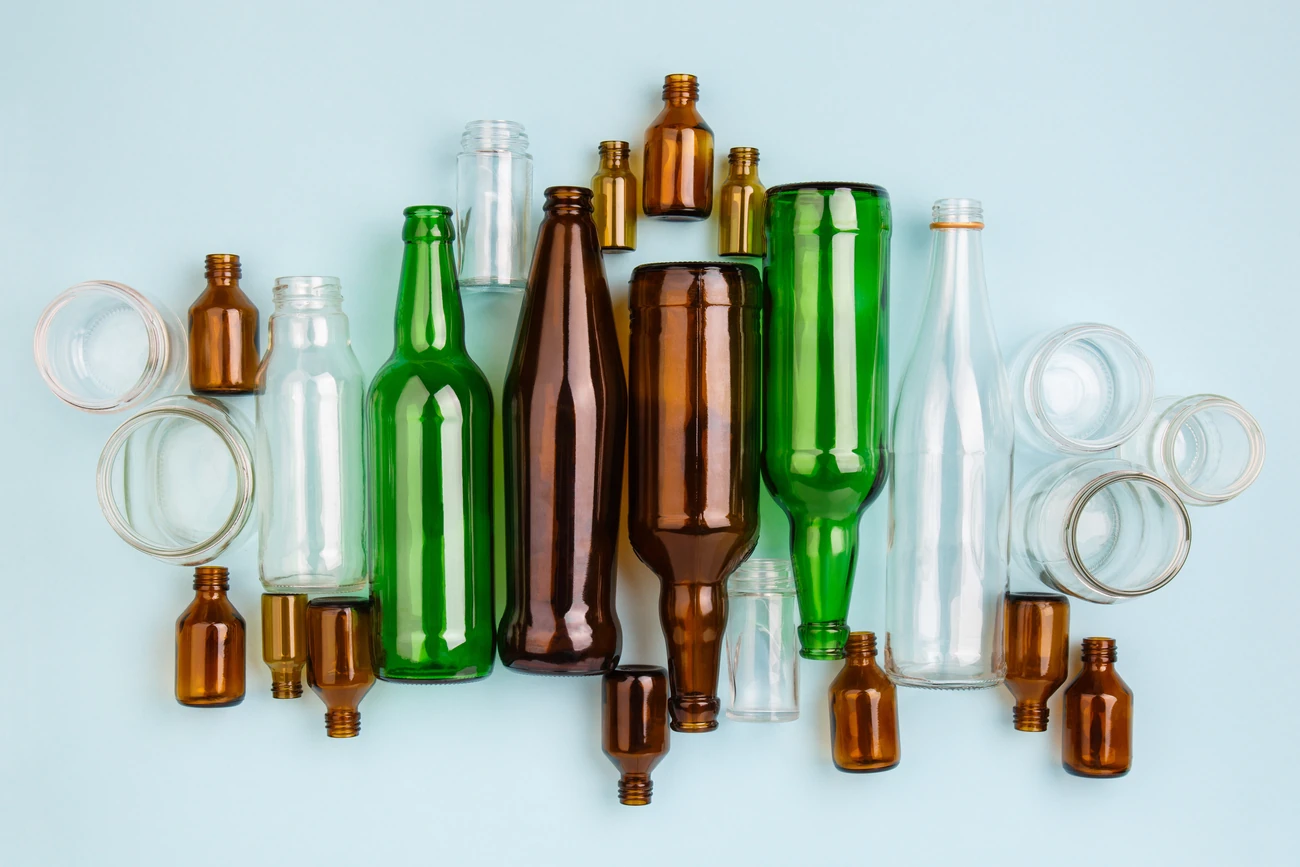
This glossary brings together commonly used glass packaging terms and organizes them by how glass containers are made, finished, sealed, and evaluated. Whether you’re selecting a bottle, troubleshooting a closure issue, or working through packaging specifications, this guide is designed to help clarify terminology and support clearer conversations across suppliers, fillers, and brand teams.
- Glass Materials & Composition
- Raw Materials that Form Glass
- Manufacturing Processes & Equipment
- Mold Systems & Tooling
- Thermal Treatment & Stress Control
- Container Geometry & Structural Features
- Finish Designs & Closure Interfaces
- Closures & Sealing Performance
- Filling, Capacity & Measurement
- Surface Decorations
- Performance & Quality
- Industry Reference
Glass Materials & Composition
Amber Glass: Brown-colored glass designed to block ultraviolet and short-wavelength visible light, helping protect light-sensitive contents.
Borosilicate Glass: High-silica glass containing boron oxide, offering strong resistance to chemical attack and thermal stress.
Flint Glass: Clear, colorless glass used when product visibility and shelf appearance are important. Depending on purity and clarity requirements, flint glass is commonly categorized into the following types:
- Commercial Flint: Standard clear glass with a slight natural tint (often faint green or blue) caused by trace iron content. Suitable for most general food, beverage, and household applications.
- High-Grade Flint: Produced with improved raw material control to reduce color tint and increase transparency. Commonly used for products where appearance and color accuracy are more important, such as premium beverages or personal care items.
- Ultra-Clear Flint: Also known as extra-clear or low-iron glass, this type offers maximum transparency with minimal color distortion. It is typically used for high-end packaging where product clarity and visual presentation are critical.
Soda-Lime Glass: The most widely used glass composition for containers, made from silica, soda ash, and limestone.
Type I Glass Borosilicate glass with the highest level of chemical resistance. It is mainly used for pharmaceutical products such as injections, where stability and purity are critical.
Soda-Lime Glass: The most widely used glass composition for containers, made from silica, soda ash, and limestone.
Type I Glass Borosilicate glass with the highest level of chemical resistance. It is mainly used for pharmaceutical products such as injections, where stability and purity are critical.
Type II Glass Soda-lime glass that has been specially treated to improve its resistance to chemical interaction. It is often used for certain pharmaceutical liquids that are less sensitive than injectables.
Type III Glass Standard soda-lime glass with moderate chemical resistance. It is commonly used for food, beverages, and some pharmaceutical products that do not require high protection.
Type NP Glass General-purpose soda-lime glass that is not classified for pharmaceutical use. It is typically used for food, beverage, and household packaging.
Colorant: Metal oxides or compounds added during melting to produce specific glass colors.
Density: The mass of glass per unit volume, commonly used to monitor glass composition consistency.
UV Transmission: A measure of how much ultraviolet light passes through the glass.
Raw Materials that Form Glass
Batch: A controlled mixture of raw materials prepared for melting into glass. The main components typically include silica (sand), soda ash, and limestone, along with recycled glass (cullet) and small amounts of additives to adjust color or performance.
Cullet: Recycled glass used as part of the batch to improve melting efficiency and reduce energy consumption. In practice, cullet typically makes up ~20% to 60% of the batch, depending on product type, color requirements, and material availability.
For flint (clear) glass, cullet levels are more tightly controlled to maintain clarity:
- Commercial Flint: ~20% – 40%
- High-Grade Flint: ~10% – 25%
- Ultra-Clear Flint: ~0% – 15%
Lower cullet percentages are used for higher clarity applications because recycled glass can introduce slight color variations.
Furnace: A high-temperature unit where batch materials are melted to form molten glass.
Forehearth: A temperature-controlled channel that delivers molten glass from the furnace to forming machines.
Gob: A gob in glass manufacturing is a precise molten cylinder of glass (at roughly 1,050-2000 degrees Celsius) that is fed into molding machines. Each gob is controlled for weight, temperature, and size to ensure consistent container quality.
In production, gobs are also used to describe machine configurations:
- Single Gob (SG): One gob forms one container per cycle
- Double Gob (DG): Two gobs are delivered at the same time, producing two containers per cycle
- Triple Gob (TG) / Quad Gob (QG): Three or four containers are formed simultaneously
Higher gob configurations increase production output but also require tighter control of glass distribution and forming conditions.
Manufacturing Processes & Equipment
IS Machine (Individual Section Machine): An IS (Individual Section) machine is made up of multiple independent sections arranged in a row. Each section functions like a small, self-contained forming unit, receiving molten glass, shaping it into containers, and transferring it to the cooling process.
The operation follows a continuous cycle:
- Molten glass flows through the forehearth and is cut into gobs
- Gobs are distributed to each section of the IS machine
- Each section forms the container through blank and forming molds
- Finished containers are transferred to the conveyor and annealing lehr
The gob configuration (single, double, triple, etc.) determines how many containers each section produces per cycle.
Blow-Blow Process: The blow-blow process is a glass forming method where compressed air is used in two stages to shape the container. First, air is used to form the molten glass into a preliminary shape (the parison) inside the blank mold. Then, after transfer to the forming mold, air is applied again to expand the glass into its final shape. This method is most commonly used for narrow-mouth containers, such as beverage bottles, where precise control of the neck and finish is important.
Press-and-Blow Process: The press-and-blow process uses a mechanical plunger to shape the molten glass during the first stage. Instead of air, the plunger presses the glass into the blank mold to form the parison, creating a more controlled distribution of material. The parison is then transferred to the forming mold, where compressed air expands it into the final container shape. This method is typically used for wide-mouth containers, such as jars, where uniform wall thickness and structural strength are important.
Parison: The parison is the intermediate shape of molten glass created during the first stage of forming, before the container reaches its final shape. It is formed in the blank mold and typically looks like a thick, partially shaped version of the final bottle, with the finish (neck area) already defined.
Section: An individual operating unit within an IS machine, where glass containers are formed through a complete molding cycle. Each section operates independently, allowing adjustments or maintenance without stopping the entire machine. IS machines typically have 6 to 12 sections, with larger or higher-capacity systems sometimes exceeding this range depending on production needs.
Take-Out: Take-out refers to the mechanical step where newly formed glass containers are removed from the forming mold and placed onto the conveyor system.
Mold Systems & Tooling
Blank Mold: The blank mold is the first mold used in the forming process. It shapes the molten glass into an initial form called the parison (or preform). At this stage, the glass is not yet a finished bottle—it is only partially shaped to prepare it for the next step.
Blanks: "Blanks" generally refers to the tooling components used in the preliminary shaping stage, but in practice, the term is also sometimes used to describe the partially formed glass itself (the parison). This dual meaning can be confusing, but in simple terms, blanks are associated with the first stage of forming, before the container reaches its final shape.
Bottom Plate: The bottom plate is the mold component responsible for shaping the base of the container. It is typically flat or slightly contoured and may include molded-in markings such as cavity numbers, manufacturer codes, or date indicators. Located at the bottom of the mold set, it ensures the container has a stable base and provides traceability information through these markings.
Cavity: A single forming space within a mold that produces one container per cycle. The number of cavities used depends on container size and production setup. Smaller containers (e.g., under 200 ml) are often produced with 2–4 cavities per section, medium sizes (200–750 ml) typically use 1–2 cavities, while larger containers (above 1 liter) are usually made with a single cavity to maintain quality and control.
Forming Mold (Bottle Mold): The forming mold, also known as the bottle mold, is where the container takes its final shape. After the parison is created in the blank mold, it is transferred to the forming mold, where air pressure is used to expand the glass to match the mold cavity. This step defines the final dimensions, surface details, and overall appearance of the container.
Guide Ring: A tooling component inside the forming machine that helps guide molten glass into the mold. It is located at the top opening of the mold (around the entry point where the glass enters) and ensures proper alignment before shaping begins. This part is not visible on the final container. Unlike the neck bead ring, which is a feature on the bottle used for handling, the guide ring is part of the machine and only functions during forming.
Mold: A mold is a set of precision metal components used to shape molten glass into a finished container. Instead of being a single piece, it is made up of multiple parts that work together during different stages of forming, such as shaping the base, body, and finish.
Mold Wear: Gradual degradation of mold surfaces that can affect container dimensions and appearance.
Neck Bead Ring: A raised circular ridge located just below the finish of a glass container. It is formed as part of the bottle and used by equipment to grip and transfer the container during production. This helps prevent contact with the body while the glass is still hot.
Neck Ring: The neck ring is the tooling component that forms the top opening of the bottle, known as the finish, including the threads or sealing surface where the cap fits. It is typically made of two split metal halves that close around the glass during forming. Located at the top of the container, it has a circular shape and plays a critical role not only in shaping the most important sealing area but also in holding and transferring the bottle between forming steps.
Parting Line: A faint line or ridge on a glass container formed where different mold components meet during the shaping process. It can appear as a horizontal or circular line around areas such as the neck, shoulder, or base. This is a normal result of molding and does not affect container performance.
Seam: A visible line that runs vertically along the side of the container, created where two halves of the mold come together. It typically extends from the top to the bottom of the bottle and is one of the most noticeable mold marks. Unlike a parting line, a seam is always vertical and follows the split between mold halves.
Thermal Treatment & Stress Control
Annealing: A controlled heating and slow cooling process used after forming glass containers. It removes internal stress created during production, making the glass stronger and less likely to break.
Annealing Point: The annealing point is not a single exact number, but a temperature range where glass can release internal stress effectively within a short time. For most container glass (soda-lime), this is typically around 540°C – 570°C (1000°F – 1060°F).
Lehr: A long, temperature-controlled oven that glass containers pass through after forming. It gradually cools the containers to complete annealing and prevent cracking.
Softening Point: The temperature at which glass begins to lose its shape and become soft under its own weight. Above this point, the glass can easily deform.
Thermal Shock: Breakage caused by sudden temperature changes, such as moving glass from hot to cold too quickly. Glass expands and contracts with temperature, and rapid changes can cause it to crack.
Residual Stress: Internal stress that remains inside the glass after forming or cooling. If not properly removed, it can weaken the container and increase the risk of breakage.
Hot-End: The part of the production line where glass is still very hot and being formed into containers. This includes forming, shaping, and the start of the annealing process. A hot-end coating is also applied at this stage to improve surface strength and help protect the glass during handling.
Cold-End: The part of the production line after the glass has cooled. Containers are inspected, tested, and packaged in this stage before shipment. A cold-end coating is typically applied here to reduce friction between containers and prevent scratches during conveying and transport.
Container Geometry & Structural Features
Body: The main volume-holding section of the container.
Shoulder: The transition area between the body and the neck.
Neck: The upper portion connecting the shoulder to the finish.
Neck Bead: A raised glass ring at the junction of the neck and finish.
Ear: A molded glass handle or grip used on larger containers.
Heel: The curved transition between the sidewall and base.
Base: The bottom surface providing stability.
Sidewall: The vertical wall of the container body.
Label Panel: A defined area intended for labeling or decoration.
Narrow Mouth: A glass container opening small relative to the body diameter.
Wide Mouth: A glass container opening large relative to the body diameter.
Finish Designs & Closure Interfaces
Finish: The shaped glass area surrounding the container opening.
Continuous Thread (CT) Finish: A helical glass thread designed to engage screw-type closures.
Lug Finish: A finish with short glass lugs that engage closures (lug caps) with a partial turn.
Pour-Out Finish: A finish designed to promote clean pouring and reduce dripping. It typically includes a slight lip, taper, or undercut just below the rim, which helps guide the liquid into a controlled stream as it leaves the container.
Sealing Surface: The top contact area of the finish that interfaces with the closure liner.
Land (Finish Land): The flat sealing area at the top of the finish.
Finish Diameter: The outer diameter of the container finish.
Finish Height: The vertical height of the finish from sealing surface to neck.
Thread Start: The point where the continuous thread begins.
Finish Compatibility: The dimensional and functional relationship between a container finish and its closure.
Closures & Sealing Performance
Closure: A device used to seal the container opening. Common closure types for glass bottles and jars include lug caps and continuous thread (CT) caps.
Application Torque: The rotational force applied when installing a closure.
Removal Torque: The force required to remove a closure after application.
Head Space: The unfilled volume between the product level and closure.
Vacuum Seal: A sealing condition where the pressure inside the container is lower than the outside air, typically created after filling hot product and cooling. The pressure difference helps pull the closure tighter against the sealing surface, improving seal integrity.
Hermetic Seal: A fully airtight seal that prevents any air, moisture, or contaminants from entering or escaping the container. It is a performance level, meaning the seal is completely tight under defined conditions.
Filling, Capacity & Measurement
Fill Point: The specified liquid level required to meet declared contents.
Meniscus: The curved surface of a liquid at the fill level due to surface tension.
Nominal Capacity: The labeled or declared container volume.
Net Contents: The actual volume of product inside the container.
Overflow Capacity: The volume of a container when it is filled until liquid just begins to spill over the top. It is typically used as a measurement reference during design and testing.
Brimful Capacity: The volume of a container when it is filled exactly to the top edge (the brim) without intentionally causing overflow. It is often used in specifications to define the container's maximum usable volume.
Grossage: A quantity measurement based on gross units, commonly used in glass packaging, with one gross equal to 144 containers.
Tolerance: The allowable variation from specified dimensions or requirements.
Surface Decorations
Acid Etching: A chemical treatment that permanently frosts the glass surface.
ACL (Applied Ceramic Labeling): A decoration method using ceramic inks fused to the glass surface.
Color Spray: A post-forming surface coating applied to clear (flint) glass bottles or jars to achieve a desired exterior color or finish, distinct from intrinsically colored glass where pigments are added to the molten glass itself.
Embossing / Debossing: A mold-integrated process that creates raised (embossed) or recessed (debossed) designs directly in the glass surface during forming, unlike applied decorations added after production.
Silkscreen: A post-forming process where inks are screen-printed onto glass to create durable graphics with a slightly raised texture.
Performance & Quality
Chemical Durability: The resistance of glass to chemical attack from contents or environment.
Dimensional Control: Maintaining critical container dimensions within specification.
Leak Test: A test used to verify container integrity and sealing performance.
Vertical Load Strength: The ability of a container to withstand compressive stacking forces.
Sterile: Indicates a container or component has been sterilized; otherwise cleaning is required before use.
Weathering: Surface degradation caused by prolonged exposure to moisture and atmosphere.
Scuffing: Surface abrasion from contact during handling or conveying.
Checking: Fine surface cracks caused by thermal or mechanical stress.
Cosmetic Defect: A visual imperfection that does not affect performance.
Industry Reference
GPI (Glass Packaging Institute): An industry organization representing glass container manufacturers and promoting standards and best practices.
Conclusion
Understanding glass packaging terminology is more than just learning definitions — it’s how brands make smarter decisions about quality, performance, and supply chain reliability. Whether you’re evaluating materials, optimizing manufacturing, or troubleshooting defects, having a clear grasp of these concepts helps you choose the right partner. As a leading glass packaging supplier, Evergreen Resources combines technical expertise with practical execution to support everything from product development to large-scale production. If you’re exploring glass packaging options, comparing suppliers, or looking to improve outcomes, our team is here to provide guidance, transparency, and solutions tailored to your needs.