

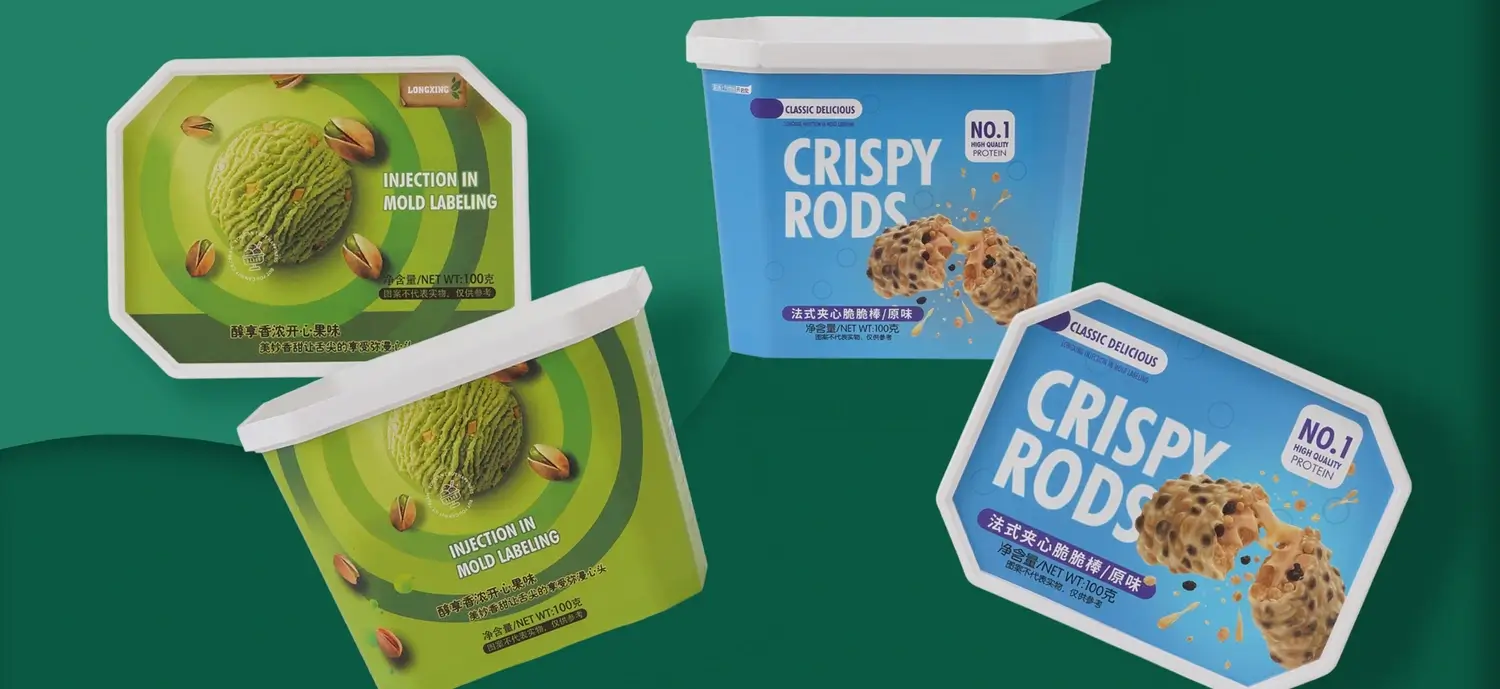

In-Mold Labeling
In-mold labeling (IML) for plastic packaging is an advanced decoration technique that integrates a pre-printed label into the product during the molding process. The process ensures that the label will not peel, fade, or delaminate over time. IML offers a premium, scratch-proof finish that is resistant to moisture, chemicals, and abrasion.
Advantages

Premium Graphics
Achieves full-color, photo-quality images and complex designs for maximum shelf impact and brand differentiation.
Seamless Integration
Fuses the label directly into the packaging surface during molding, creating a smooth, non-label look without additional adhesives.
Exceptional Durability
Provides a scratch-resistant, moisture-proof, and chemical-resistant finish that will not peel, fade, or delaminate over time.
Efficient Production
Integrates labeling into the molding process, eliminating secondary labeling steps to enable high-speed production.

Process
In-mold labeling (IML) for plastic packaging follows a systematic, high-precision process to integrate printed labels directly into containers during molding, producing seamless and durable designs. Each stage is critical to achieving superior adhesion, clarity, and longevity of the final product.

Artwork and Label Design
The process begins by creating high-resolution, full-color artwork tailored to the product’s dimensions and shape. The design is optimized for distortion, mold draft angles, and label positioning to ensure accurate alignment and flawless appearance after molding.

Label Preparation
Labels are treated with antistatic agents or coatings to reduce dust attraction and prevent curling. Depending on the feeding mechanism of the molding equipment, they are either stacked, separated, or wound into rolls.

Molding Process
Molten plastic resin is injected or blown into the mold, flowing over the label and fusing it into the container wall. The combination of heat and pressure causes the label to bond seamlessly with the plastic, resulting in a single, unified structure.

Post-Mold Finishing
Any necessary trimming, degating, or finishing operations are performed to remove excess material or sharp edges. Surfaces are inspected to confirm that labels are fully bonded and free from defects.

Label Printing
Labels are printed using specialized techniques – typically offset or flexographic printing – on materials compatible with the resin used for the final product. Printed labels may include images, text, barcodes, and are cut to precise dimensions with marks for accurate placement.

Mold Setup and Label Placement
Labels are accurately positioned inside the open mold cavity, held securely in place with vacuum ports, static electricity, or mechanical pins to prevent shifting during resin injection.

Cooling and Ejection
The molded item, now with the integrated label, is cooled inside the mold to set the shape and bond. Once solidified, the container is ejected from the mold, with the label fully embedded on its surface.

Quality Control and Inspection
Each container is checked for label adhesion, print clarity, edge alignment, and surface quality. Automated vision systems or manual inspection may be used to ensure consistency and reject any defective items before final packaging.
By integrating the label into the molding process, in-mold labeling produces packaging that is durable and efficient to manufacture.
Applications
In-mold labeling (IML) is widely adopted across food & beverage, dairy, personal care, home care, and industrial packaging segments for its combination of vibrant, high-resolution graphics and robust, long-lasting decoration.

Plastic
Plastic Bottles and Jars
Plastic Cartridges
Pouches and Bags
Films
Other Plastic Containers
In-Mold Labeling is a highly advanced decoration method that creates seamless, photographic-quality finishes with 360° coverage, ideal for products requiring robust decoration durability. At Evergreen Resources, we provide specialized in-mold labeling services for a variety of rigid plastic packaging. Our expertise ensures proper label integration, consistent edge-to-edge graphics, and unmatched durability across diverse product forms.
Related Products

Plastic Bottles

Cartridges

Pouch Packaging

Get Started
Let's get the conversation started.
Tell us a bit about you, and our team will reach out as soon as possible.