

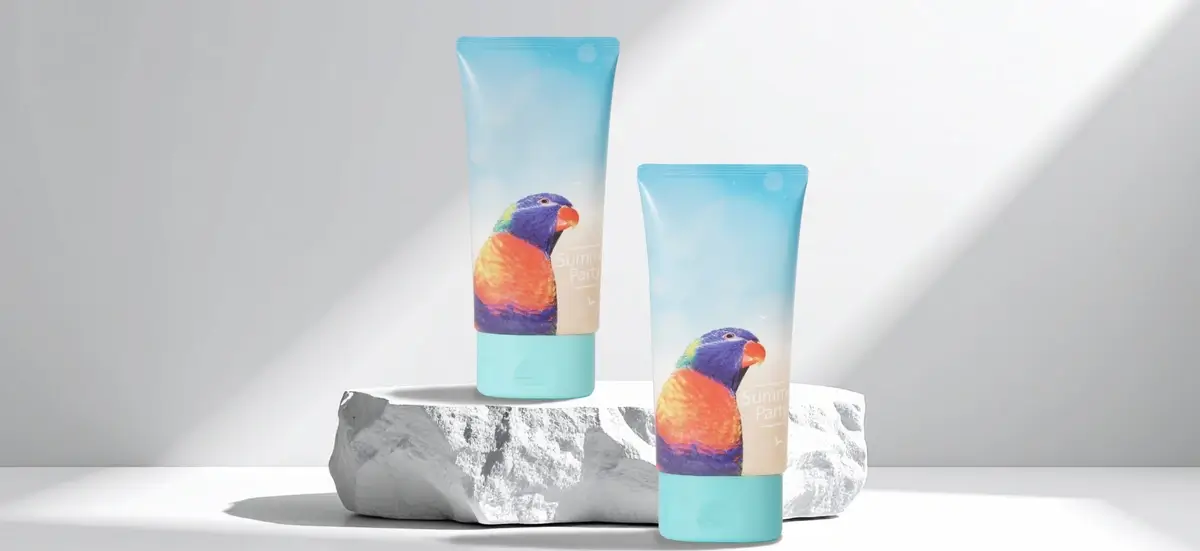

Flexographic Printing
Flexographic printing is a high-speed printing process that uses flexible relief plates to apply ink onto packaging surfaces. The technique involves creating raised image areas on printing plates, which are mounted onto rotating cylinders in a press. Each color in the design requires a separate plate and printing station, with precise registration to ensure clean, multicolor output. Flexography is widely used in producing tubes, labels, and flexible packaging due to its efficiency, versatility, and ability to run in line with finishing processes.
Advantages

High-Speed Production
Ideal for large-volume runs with fast-drying inks and continuous roll-to-roll printing, maximizing throughput and efficiency.
Consistent Quality
Delivers sharp, repeatable prints with excellent registration, making it suitable for designs with solid areas and simple color patterns.
Cost Efficiency
Lower ink consumption and faster setup make it economical for high-volume production compared to other printing methods.
Inline Capabilities
Supports inline processes like varnishing, laminating, die-cutting, and perforating, reducing production steps and time.

Process
Flexographic printing follows a continuous, high-speed process that uses flexible relief plates to transfer ink onto a wide range of substrates. Each step is critical to ensuring print consistency, color registration, and production efficiency.

Design Preparation
The process begins by preparing the artwork, which is separated into individual color layers. Each layer corresponds to a separate printing plate. Design files are optimized for flexo printing constraints such as color trapping, halftone angles, and line thickness.

Ink Preparation
Fast-drying, low-viscosity inks (water-based, solvent-based, or UV-curable) are prepared and adjusted for optimal viscosity and pH levels. Ink formulations are chosen based on the substrate type and end-use requirements, such as food safety or outdoor durability.

Machine Setup
Plates and rollers are installed on each print station. The web (substrate roll) is loaded and tensioned. The flexographic press is calibrated for web alignment, print pressure, ink transfer, and drying speeds. If required, inline units such as laminators, die-cutters, or varnishers are also configured.

Drying and Curing
Printed sections are rapidly dried or cured depending on the ink system used. Water-based and solvent-based inks use heated air dryers, while UV inks are cured instantly with UV lamps to ensure sharpness and adhesion.

Quality Control and Inspection
The final output is monitored for print clarity, color accuracy, registration, and defect-free surfaces. Automated camera systems may be used for real-time inspection, and periodic manual checks are conducted throughout the run.
By following these steps, flexographic printing delivers a fast, high-quality, and cost-effective decoration solution for a wide range of packaging types, supporting both functional performance and strong visual branding.

Plate Making
Printing plates are created for each color. The image area is raised while the non-image area remains recessed. These flexible plates are then trimmed and mounted onto printing cylinders with precise registration marks.

Anilox Roller Setup
An anilox roller – a ceramic-coated roller engraved with microscopic cells – is used to measure a controlled amount of ink from the ink tray to the printing plate. The cell volume and line screen of the anilox roller are selected to match the ink type and image detail.

Printing Process
As the substrate moves through the press, ink is transferred from the anilox roller to the raised areas of the plate and then onto the substrate. Each print station applies one color, with drying units (hot air or UV lamps) positioned between stations to prevent smudging.

Inline Finishing (If Applicable)
Optional finishing processes such as varnishing, laminating, die-cutting, or perforating are executed inline. This enables the entire decoration and converting process to be completed in one continuous run.
Applications
Flexographic printing is used in personal care, home care, food & beverage, and industrial packaging due to its speed, versatility, and ability to deliver high-quality graphics on a wide range of materials.

Plastic
Tubes
Plastic Cartridges
Pouches & Bags
Films
Flexography is a highly efficient printing method that produces consistent, clean results with excellent registration across long production runs. It excels in reproducing solid colors, barcodes, and brand graphics with precision. From scaled efficiency to compelling branding, flexography offers numerous benefits that meet the demands of today’s competitive market.
Related Products

Tube Packaging

Cartridges

Pouch Packaging

Get Started
Let's get the conversation started.
Tell us a bit about you, and our team will reach out as soon as possible.